
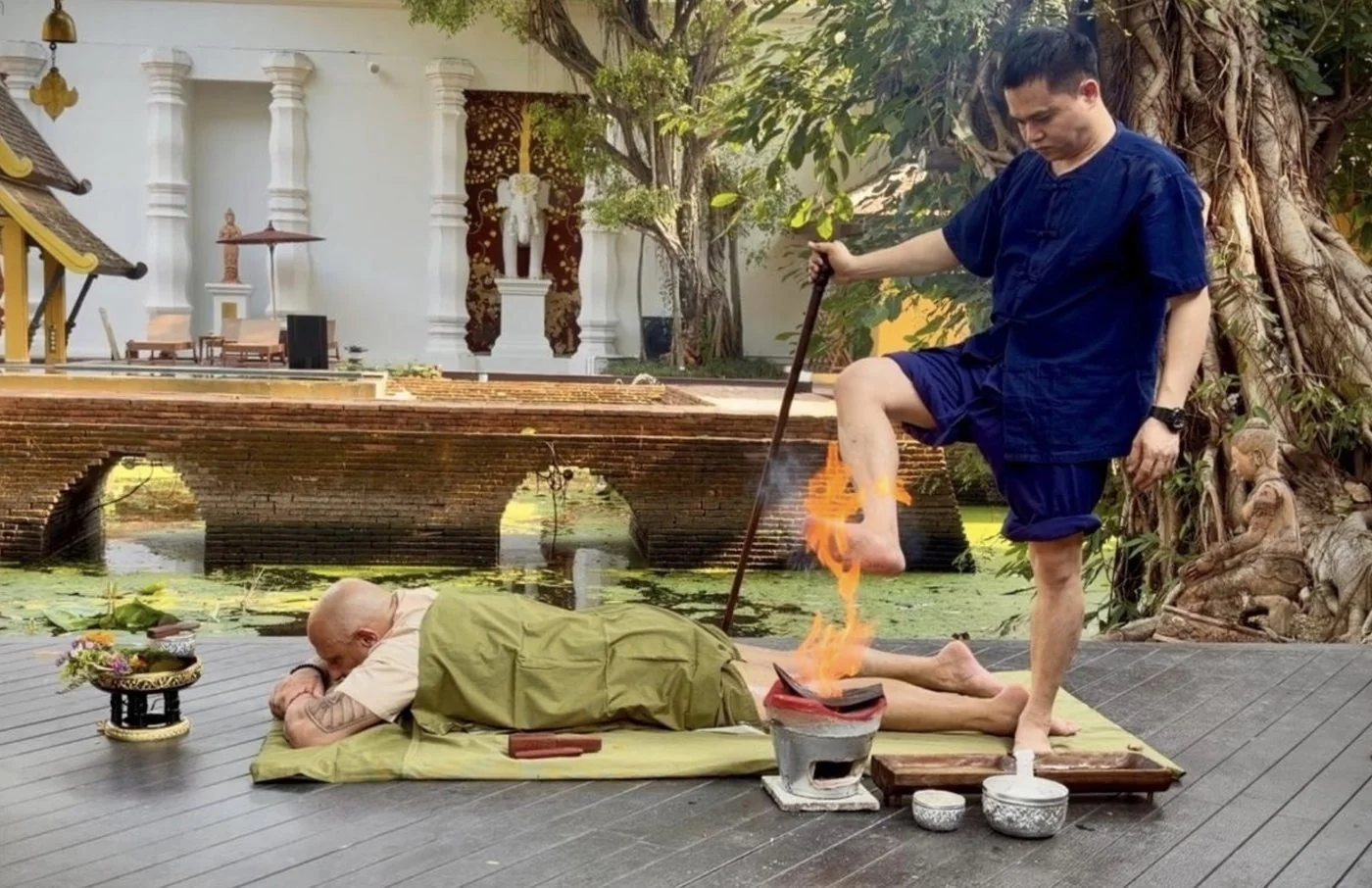
Somewhere in the hills of Northern Thailand, a fire is still being lit the old way, not for warmth, not for cooking, but for healing. A metal blade rests in the coals until it glows. A practitioner dips their bare foot into sesame and plai oil, presses it briefly against the scorching metal, and then, without hesitation, places that same foot directly onto another human being’s back.
This is Yam Khang, known in Thai as ย่ำขาง. It is often softened for outsiders into the phrase “Thai fire massage,” a translation that flatters the marketing brochure far more than it honours the practice. What is actually happening here is closer to an act of controlled danger performed in the name of care, a ritual balanced on the exact edge between injury and relief. And it is dying.
Forged by the Fields, Not the Spa
Yam Khang was never born in luxury. It was born in exhaustion.
In the old Lanna Kingdom, around what is now Chiang Mai, farmers spent their lives bent over rice paddies, and their bodies paid the bill. Chronic back pain, curved spines, stiffened joints, and muscle fatigue were simply the price of survival, and with little access to formal medicine, communities turned to the healers among them, the ones who understood the body not as a machine but as a landscape that could be worked, like soil.
The name itself carries that meaning forward. “Yam” means to step, to press. “Khang” is the plough. The logic is unsentimental and precise, the same way a plough breaks open hard earth to let new growth in, the heated blade is believed to break open the body’s stagnation, working stuck pain the way a farmer works stuck ground. The plough was never a random choice of tool. In agrarian life it represented survival itself, fertility, provision, the difference between a family that ate and one that did not. Carrying that symbolism into the healing room was never decoration. It was the entire point.
An Act That Should Not Work, and Somehow Does
Describe the mechanics of Yam Khang plainly and it sounds like something no sane person would volunteer for.
A blade or iron plate is heated over charcoal until it is close to searing. The practitioner’s foot is oiled, briefly touched to the hot metal, and pressed straight onto the client’s skin, again, and again, in a continuous rhythm, the practitioner often balancing on a wooden staff to control their own weight and force. The oil can hiss against the metal. Occasionally it flares. To anyone watching from outside the tradition, it looks less like therapy and more like something a person survives rather than receives.
And yet the burn does not come. Not because the fire has been softened, but because the skill has been sharpened. A trained practitioner reads the exact interval between heat and skin, the precise amount of oil, the speed of contact, turning what should be an injury into a wave of deep, penetrating warmth instead. This is not a technique that tolerates approximation. There is no safe version of getting it almost right.
The Body as Something More Than Tissue
Underneath the spectacle sits a far older idea, one that traditional Thai medicine shares with acupuncture and Ayurveda, that the body is threaded with energy pathways, known here as Sen lines, and that illness is often nothing more than a blockage in that internal current.
The heated foot is not simply applying pressure. Within this worldview it is believed to move stagnant energy, break up what has calcified, and restore a kind of internal circulation that has nothing to do with blood alone. Yam Khang was never treated as a neutral skill anyone could pick up. It was considered sacred work, reserved for those judged to have the discipline, the moral grounding, and often the family lineage to be trusted with it. In many villages, the knowledge never left the bloodline at all, passed quietly from one generation of healers to the next, refined but rarely written down.
What the Fire Actually Treats
Set the ritual aside for a moment and the physical case for Yam Khang still holds up, echoing much of what traditional Thai massage is already known for, with heat added directly into the equation.
It has long been used for muscle soreness, joint pain, tendon and ligament complaints, and the kind of chronic back pain that outlives a single treatment, precisely the injuries its farming originators lived with daily. The combination of heat and firm pressure is understood to support circulation and tissue elasticity, and Thai bodywork more broadly has been associated with improved flexibility and mobility through better blood flow and oxygen delivery to overworked muscle. Practitioners have also used it for stress reduction and nervous system calming, an almost contradictory outcome given how intense the process looks from the outside, and in some traditional accounts, for numbness and even mild paralysis, treated as circulation and nerve stimulation problems rather than purely structural ones.
Why the Fire Is Going Out
A tradition this demanding was never going to survive by accident, and increasingly, it is not surviving at all.
It cannot be taught in a weekend. It demands exact heat control, physical balance under real strain, and a depth of anatomical understanding that takes years to earn, and the margin for error is a burn, not a bruise, which is exactly the kind of risk that modern practitioners are trained to avoid rather than master. Layered on top of that is the weight of tradition itself, a practice once considered sacred enough to require ethical discipline or spiritual initiation is never going to scale the way a wellness trend needs to scale. Meanwhile the commercial machinery of modern spa culture has moved in the opposite direction entirely, rewarding what is gentle, photogenic, and easy to sell over what is barefoot, loud, and lit with fire. Knowledge that once passed quietly through families now runs into a generation pursuing different careers entirely, and a modern regulatory environment understandably hesitates at a therapy built around open flame and heated metal against bare skin. None of these pressures had to conspire. Any one of them alone would have been enough.
Even inside Thailand, Yam Khang is now openly described as at risk of dying out, kept alive by a shrinking number of practitioners still willing to teach it. Some resorts and traditional schools have begun reviving it as a cultural preservation piece, which is a genuine act of care, but it carries its own quiet danger. A sacred practice reshaped for an audience of tourists risks keeping the spectacle and losing the meaning underneath it.
What We Actually Lose When a Tradition Like This Disappears
It would be easy to file Yam Khang away as an unusual massage technique and move on. That would be a mistake.
What is actually at stake is a worldview, one where the body is inseparable from energy and environment, where the tools of ordinary survival, in this case a farmer’s plough, carry meaning far beyond their function, and where healing is treated as a spiritual act as much as a physical one. This is not clinical theory handed down through textbooks. It is knowledge earned through lived hardship, refined by hand, and trusted only to those judged ready to carry it.
If Yam Khang disappears, the loss will not simply be a technique. It will be a language for understanding pain, the body, and healing itself, one that took generations to build and cannot be reconstructed from a manual once the last hands that know it stop practising. It survives, for now, only in the feet of the few who have learned to walk through fire without being burned by it, and in whether anyone still cares enough to learn how they do it.
Frequently Asked Questions
What is Yam Khang?
Yam Khang, or ย่ำขาง, is a traditional Thai fire massage from the Lanna region of Northern Thailand, in which a practitioner heats a metal blade or plough over charcoal, oils their foot, and presses it against the client’s body to relieve pain and stimulate the body’s energy pathways.
Is Yam Khang safe?
When performed by a properly trained practitioner, yes. The technique relies on precise timing, oil application, and controlled contact to deliver deep heat without burning, though the skill required to do this safely is exactly why the practice is becoming rare.
Why is Yam Khang disappearing?
It requires years of difficult, high-risk training, was traditionally restricted to those with specific moral or spiritual standing, and has been overtaken commercially by gentler, easier-to-market spa treatments, leaving only a small number of practitioners still teaching it.
What conditions is Yam Khang traditionally used for?
It has traditionally been used for muscle soreness, joint pain, tendon and ligament issues, chronic back pain, poor circulation, stress, and in some cases numbness or mild paralysis.