
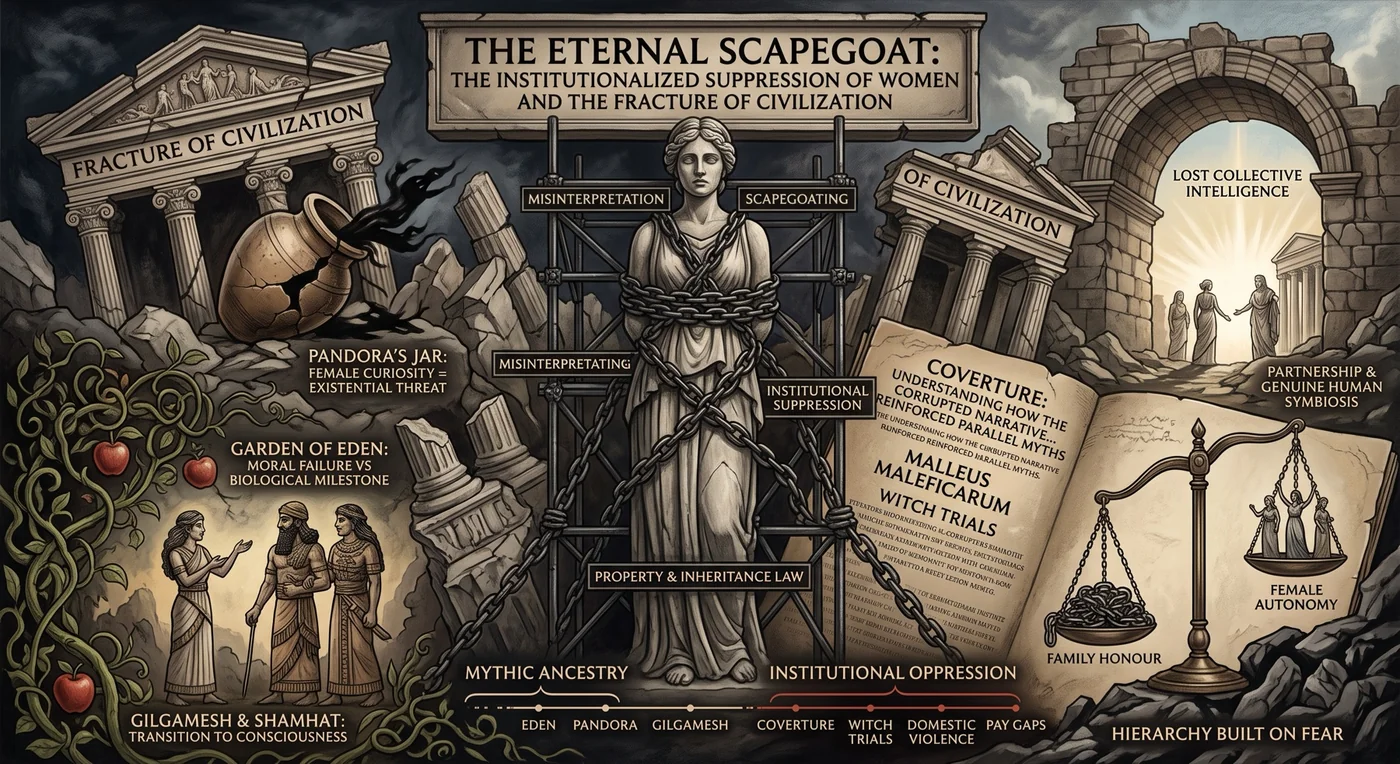
Every human society runs on a fundamental operating system composed of invisible narratives. These narratives dictate how we structure authority, construct legal systems, process suffering, and assign value to human life. When the foundational stories of a civilization are misread, the error does not remain confined to theology or folklore: it ripples outward through history, corrupting legal frameworks, scientific paradigms, political hierarchies, and interpersonal dynamics.
At the centre of Western civilization lies a catastrophic narrative misinterpretation: the framing of the Garden of Eden as a story of moral failure rather than a biological milestone, and the subsequent scapegoating of Eve as the primary architect of human suffering. To understand the full magnitude of this ideological fracture, we must examine how this single corrupted narrative intersected with, absorbed, and reinforced parallel myths across disparate cultures. Across antiquity, whenever societies attempted to grapple with the disorienting arrival of metacognition, the birth of self-awareness, and the inevitable burden of existential dread, they repeatedly created origin myths that weaponised curiosity and projected the discomfort of consciousness onto women. The Edenic misinterpretation became the master template, and its destructive power was amplified by a web of convergent mythologies that calcified into institutional oppression.
Eden and Pandora: A Shared Template
In Greek mythology, the story of Pandora provides a striking structural parallel to the misread Genesis narrative. Hesiod’s retelling frames the first mortal woman not as a masterpiece of creation but as a divine curse: a punishment sent by Zeus to avenge Prometheus’s theft of fire. Pandora’s defining traits were curiosity and beauty, traits weaponised by the gods to bring about the undoing of man. When she opened the jar, releasing sickness, toil, and existential dread into the world, Greek culture encoded a message nearly identical to the corrupted Eden story: female curiosity is an existential threat, and women are the gateway through which suffering enters human existence. This narrative directly informed classical Athenian law, where women were legally classified as perpetual minors, denied civic agency, and sequestered within the domestic realm under the guardianship of male relatives.
Gilgamesh and the Question of Blame
Further east, a related but more contested pattern appears. In the Epic of Gilgamesh, the wild man Enkidu is civilised through his encounter with Shamhat, a sacred priestess. Shamhat introduces Enkidu to human consciousness and culture, but this transition also severs his harmonious connection with nature and introduces him to mortality. It’s worth noting this episode doesn’t carry the punitive framing of Eden or Pandora: Shamhat isn’t blamed or cursed, and many scholars read her role as constructive rather than catastrophic. What the story does share with the other two is the underlying structural move: a female presence acts as the catalyst that strips man of primal innocence and drags him into the burden of conscious existence, whether or not that transition is coded as a moral failing. Even in traditions where female energy was acknowledged as powerful, such as early Vedic thought or later Asian folklore, patriarchal systems tended to reframe active female agency as chaotic or dangerous, something requiring male mastery to prevent social and cosmic disorder.
From Myth to Law
The lasting power of these narratives lies in how they hardened into institutional power. In medieval Europe, the misreading of Eve converged with classical Aristotelian views of women as biologically deficient beings, alongside the property and inheritance logic already embedded in Roman and Germanic law, to help entrench the doctrine of coverture. Under coverture, a woman’s legal identity was subsumed by her husband upon marriage: she could not own property, enter contracts, retain independent earnings, or exercise legal rights over her children. This was framed not as tyranny but as a protective measure against a gender believed to be morally fragile and incapable of self-governance. The clearest direct line runs through the witch trials of the early modern period, where texts like the Malleus Maleficarum explicitly cited Eve’s transgression as proof that women were naturally prone to corruption, a justification that underwrote the torture and execution of tens of thousands of women.
Honour as Inherited Liability
This inversion of responsibility created a deep cultural pathology around pride, honour, and dignity. Across Mediterranean, Middle Eastern, and South Asian societies, family honour became physically localized in female chastity and conduct. Men built legal and cultural frameworks that held women responsible for protecting or destroying an entire lineage’s moral standing, while denying those same women the autonomy to govern their own lives. If a family suffered social disgrace or economic decline, female conduct was scrutinized as the root cause, letting men escape accountability for their own choices, violence, and institutional failures. A woman was expected to be the flawless vessel of a family’s dignity while simultaneously being treated as a potential serpent capable of bringing about its ruin.
The Cost of the Mistake
By systematically projecting the pain of existence onto women, civilization foreclosed the possibility of genuine human symbiosis. The original design of partnership, where 1 × 1 = 1, was replaced by a hierarchy built on fear, subjugation, and control. When society silenced half of humanity, it severed itself from half of its collective intelligence, emotional resilience, spiritual depth, and creative wisdom. The result is a civilisational friction that persists today in systemic pay gaps, domestic violence, the underrepresentation of women in governance, and the ongoing struggle for bodily autonomy.
Eden, Pandora, and Gilgamesh are not identical stories, but they share a structural fingerprint: curiosity and consciousness routed through a female figure, then punished as if she had caused what she only witnessed. Curiosity was an evolutionary leap. Self-awareness is a shared human inheritance. Women were never the cause of human suffering. Restoring civilization means discarding the corrupted reading of these myths, holding men and women equally accountable for the human condition, and rebuilding our institutions on partnership rather than blame.
This entry has a long-form companion: The Garden We Never Left, an essay that takes the Genesis text, Tertullian, Augustine and the science of self-awareness one at a time.