
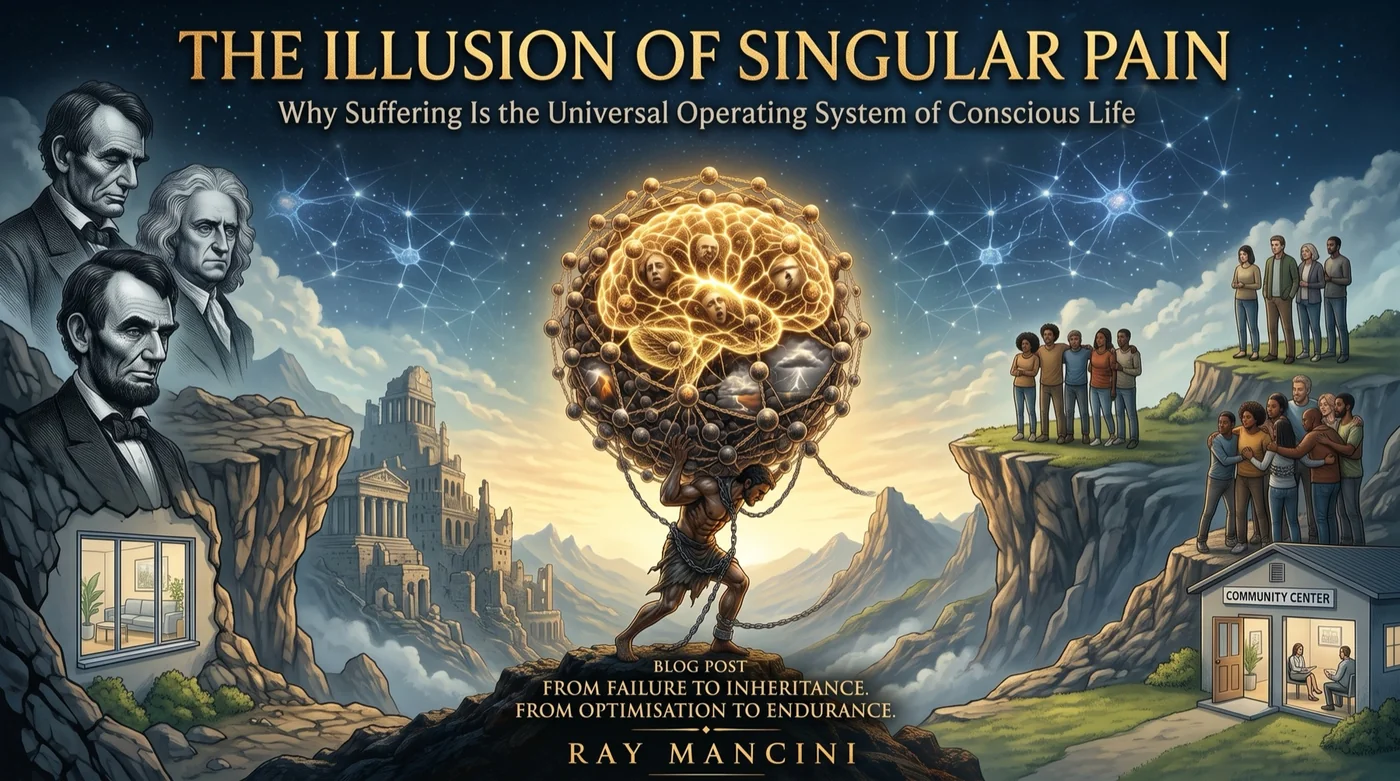
We live in a culture obsessed with the optimisation of happiness. Social media feeds, self-help industries, and wellness paradigms sell a persistent, implicit promise: if you manage your habits correctly, optimise your routine, and maintain the right mindset, suffering can be permanently engineered out of your existence.
As a result, when depression, chronic anxiety, or existential dread strike, the modern individual suffers twice. First, from the raw weight of the psychological distress itself. Second, from a pervasive, crushing sense of isolation and personal failure. The dominant narrative tells us that our pain is an anomaly: a glitch in our specific software, a unique defect in our personal choices, or a tragic exception to a world where everyone else seems to be flourishing.
This is perhaps the most profound collective delusion of our time. By viewing personal anguish as a private catastrophe rather than a fundamental feature of human consciousness, we have severed ourselves from history, from reality, and from one another.
To understand why our expectations around suffering are so misaligned with truth, we only need to look at the historical record of humanity’s greatest minds. If the individuals responsible for our most brilliant breakthroughs in science, art, philosophy, and governance could not engineer a life free of mental anguish, why do we treat our own struggle as a personal defeat?
The Genius Paradox: The Price Tag of Metacognition
Throughout history, the minds that illuminated the darkest corners of human ignorance were often haunted by intense psychological torment.
Consider the historical ledger: Isaac Newton, who codified the laws of motion and universal gravitation, lived through a documented period of severe paranoid isolation and emotional breakdown in his early fifties, marked by delusions and estrangement from friends. Abraham Lincoln, who navigated a nation through its deadliest crisis and redefined human freedom, battled a clinical, crippling melancholia throughout his life so severe that friends reportedly removed razors from his room during his darkest episodes. Vincent van Gogh, Virginia Woolf, Leo Tolstoy, and Charles Darwin, figures who fundamentally expanded human vision, literature, and biological science, all endured relentless depression, debilitating anxiety, substance dependence, or profound existential terror.
Why is this pattern so pervasive? Why does extraordinary insight so rarely coexist with serene contentment?
Part of the answer lies in the nature of metacognition: the human ability to think about thinking, to project into the future, to dissect the past, and to recognise our own mortality. The same mental apparatus that allows a person to perceive subtle patterns in nature, express the nuances of human emotion, or foresee societal failure is capable of amplifying internal distress. It’s worth being honest about the limits of this pattern too: history remembers the suffering of the brilliant because their suffering was documented, not because we have any real way of counting the equally brilliant minds who lived quieter, steadier lives and left no dramatic record behind. The ledger above is suggestive, not proof. What it demonstrates reliably is that intellectual or creative achievement offers no immunity from psychological pain, not that pain is the price of admission for insight.
Higher sensitivity does appear to be a double-edged instrument in many of these lives. A mind tuned to pick up on fine frequencies will hear the music of the universe, but it will also register its dissonance more sharply. Genius does not grant immunity from the human condition. In many of the lives above, it seems to have intensified it.
The Ego’s Trap: “My Pain Is Special”
If suffering has always run through even the most capable and accomplished lives, why is the average person so convinced that their depression or anxiety is a uniquely personal failure?
The human ego operates on a mechanism of self-centred narrative construction. When we experience intense physical or emotional pain, our attention narrows inward. Pain demands an audience; it insists that it is the centre of gravity in the room. In doing so, it creates a powerful optical illusion: it makes our experience feel completely isolated.
When a person struggles with depression today, the internal monologue often sounds like this: “Why can’t I just be happy like everyone else?” “What is wrong with me that I can’t handle daily stress?” “My life is broken because I feel this way.”
This line of thinking relies on two flawed assumptions. The first is the assumption of normative bliss: the false belief that “normal” human life is naturally peaceful and that suffering represents a disruption of the baseline. The second is the myth of unique defect: the belief that while others might experience “mild stress,” one’s own deep dread or apathy is a singular weakness of character.
When millions of people simultaneously believe that their pain makes them uniquely broken, the result is a society of isolated individuals performing happiness for one another while quietly carrying the same shared weight.
Existential Weight and Clinical Illness Are Not the Same Thing
Before going further, it matters to draw a clear line here, because collapsing it does real harm. Existential dread, the ache of mortality-awareness, grief, and ordinary stress are part of the shared architecture of a reflective life, and no one should feel broken for experiencing them. Clinical depression, generalised anxiety disorder, and substance use disorder are a different category: diagnosable conditions with biological components, and conditions that respond to treatment.
The claim of this essay is that suffering is not evidence of personal weakness or failure, not that suffering, once it becomes clinical, is something to simply endure as a philosophical inevitability. Newton and Lincoln lived before modern psychiatry, neuroscience, or evidence-based treatment existed. Their struggles are proof that even extraordinary minds are not exempt from psychological pain; they are not a model for how to manage it. Where suffering has become persistent, severe, or is affecting someone’s ability to function or stay safe, professional support changes outcomes. Universality removes shame. It does not replace treatment.
The Inescapable Arithmetic of Existence
If minds with vast intellectual resources, creative outlets, and historic achievements could not eliminate suffering from their lives, no one should expect to construct a life completely free of it. Life, by its physical and existential structure, involves loss, decay, uncertainty, rejection, physical decline, and mortality. To possess consciousness in a world governed by these realities is to experience friction.
Expecting to go through life without periods of acute anxiety, sadness, or existential despair is like expecting to jump into the ocean and stay dry. The expectation itself is often the deeper source of suffering, not the pain itself but the belief that its presence means something has gone wrong.
The Great Relief: From Failure to Inheritance
This realisation, properly framed, is not pessimistic. It is one of the more liberating truths available.
- The death of self-blame. If feeling overwhelmed, depressed, or anxious is a reality that runs through both history’s most capable minds and everyday people, your struggle is not proof that you are weak or broken. You are not failing at life; you are experiencing the reality of being a conscious, feeling entity in a world that includes loss and uncertainty. The shame attached to mental pain loosens considerably once it is no longer read as a personal verdict.
- The shift from elimination to navigation. When you stop spending energy chasing an impossible state of perpetual contentment, that energy becomes available for what actually matters: building resilience, finding meaning, cultivating endurance, and seeking support when the weight is more than existential. The goal is no longer to eliminate the storm but to build a vessel that can hold it, and to know when to bring in help crewing it.
- Reclaiming true human connection. Recognising the universality of suffering weakens the wall of isolation. Your anxiety does not make you an outsider; it links you to the human story, to the neighbour down the street, and to the stranger on the train. Everyone is carrying some form of weight.
The Ordinary Advantage
There is one place where the average person holds a genuine advantage over the historical “genius,” and it deserves more than a passing mention, because it’s the most actionable part of this entire framing.
The figures on the historical ledger were rarely just brilliant; they were often consumed, isolated, and structurally cut off from the very things that make suffering survivable. Newton spent long stretches in near-total isolation, estranged from ordinary social contact, absorbed in work that few people around him could even understand, let alone share. Lincoln carried the weight of a fracturing nation largely alone, filtered through the crushing formality and scrutiny of public office, with almost no space to be simply unwell in private. Van Gogh’s isolation was compounded by poverty and repeated social rejection; Woolf’s brilliance came bundled with a public and literary life that offered little room to withdraw and recover quietly. Obsession, historical significance, and public exposure are not neutral conditions. They actively strip away the ordinary buffers, community, unremarkable daily company, the freedom to be low-functioning for a week without consequence, that make suffering more bearable.
This is the actual advantage of an ordinary life, and it is worth naming specifically rather than gesturing at:
- Unremarkable relationships are a resource, not a consolation prize. A friend who checks in, a partner who notices you’ve gone quiet, a colleague who covers for you on a bad week: none of this requires historical significance to exist, and all of it is protective in ways that isolated genius rarely had access to.
- You are allowed to be inconsistent. Newton could not have a mediocre decade and still be Newton. Most people can have a mediocre year and simply continue being themselves. The absence of world-historical expectation is not a smaller life; it is room to recover without an audience.
- Modern tools were not available to any name on that ledger. Evidence-based therapy, psychiatric medicine, a basic cultural vocabulary for describing what’s happening internally, none of this existed for Lincoln or Newton in any usable form. Access to these tools, however imperfect, is a genuine structural advantage the ordinary person alive today has over the historical genius.
- Rest without the eyes of history watching is not a small thing. Public brilliance comes with a permanent audience. Most suffering, for most people, can happen privately, be tended to privately, and resolve without ever becoming part of a public record. That privacy is protective, not a lesser form of struggle.
Suffering is close to universal. Solitude inside that suffering, however, is closer to a choice than a certainty, one made more likely by isolation, shame, and the belief that reaching out is itself a form of failure. You are not the first person to stand in the dark, and you will not be the last. The darkness is not proof you have lost your way. It is proof that you are awake, and being awake was never meant to be carried alone.