

Allostatic load is the cumulative wear and tear on your body caused by chronic, unresolved stress. First described in 1993 by researchers Bruce McEwen and Eliot Stellar, it explains why prolonged stress, not a single stressful event, is what drives long-term disease risk, accelerated ageing, and burnout.
Every stressor you absorb, every disrupted night, every skipped meal, every unresolved emotional strain, gets written into a ledger your body keeps whether you’re paying attention or not. The problem isn’t that your body adapts to stress. The problem is what happens when it never gets the chance to stop adapting.
When stress becomes chronic rather than episodic, the very systems designed to protect you start to wear you down. Cortisol stops being a tool and becomes a liability. Inflammation stops resolving. Sleep stops restoring. Over years, this accumulation shows up as metabolic dysfunction, cardiovascular strain, cognitive decline, and premature biological ageing. Most people never see it coming, because conventional healthcare is built to look at isolated numbers on a lab report, not the interconnected system those numbers belong to.
This is where the conversation needs to change.
What Causes Allostatic Load?
Traditional healthcare tends to treat the body as a machine with individual parts: a cortisol reading here, a cholesterol panel there, each measured against a broad population average. But allostatic load isn’t a single-part failure. It’s a breakdown in the relationship between systems: your nervous system and your gut, your hormones and your sleep, your mind and your muscles.
I built my work around a different premise, one I call The Symbiotic Shift: the body is not an isolated biological vessel. It is an interconnected ecosystem, and health is what happens when every part of that ecosystem works in mutual, harmonious support of every other part. High allostatic load, from this lens, isn’t just poor stress management. It’s a rupture in that internal and external symbiosis.
What Are the Symptoms and Stages of Allostatic Overload?
The cascade works in three stages.
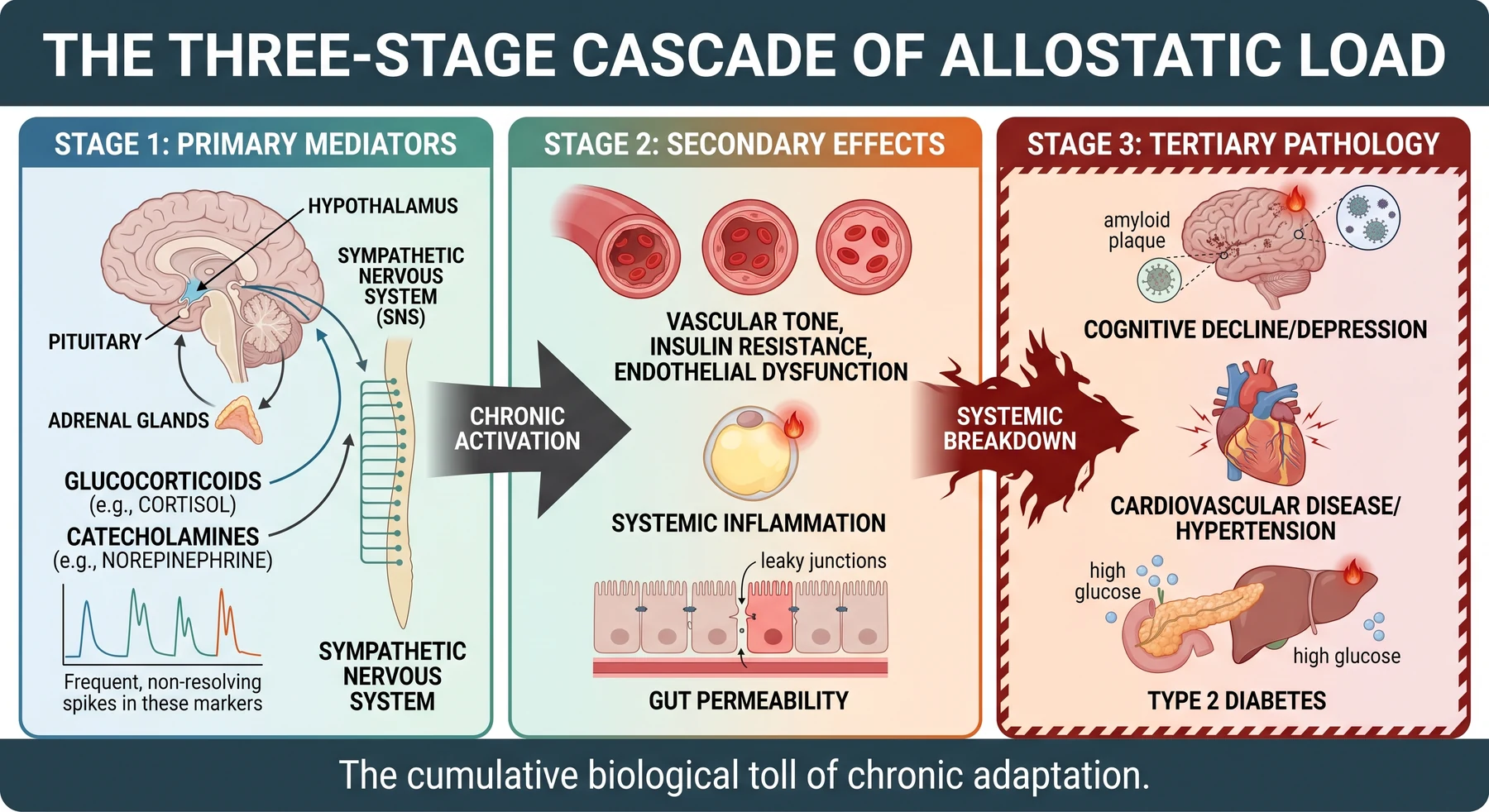
- Primary mediators: Stress hormones and neurotransmitters spike as the hypothalamic-pituitary-adrenal axis and sympathetic nervous system activate.
- Secondary effects: Left unchecked, this drives insulin resistance, vascular dysfunction, abdominal fat accumulation, and rising inflammatory markers.
- Tertiary pathology: Over time, these shifts calcify into clinical conditions: depression, hypertension, type two diabetes, and autoimmune disease.
By the time most people feel the symptoms, the damage has already been accumulating quietly for years. Common early warning signs include disrupted sleep, stubborn midsection weight, brain fog, low resilience to minor stressors, and a resting heart rate that no longer settles quickly after exertion.
How Do You Measure Allostatic Load?
You cannot fix what you refuse to measure properly. A true picture of allostatic load requires tracking across four interconnected domains: neuroendocrine signalling, immune activation, metabolic regulation, and autonomic balance. That means looking at:
- Cortisol awakening response and diurnal slope, plus DHEA-S ratios
- Catecholamine output (urinary epinephrine and norepinephrine)
- HbA1c and fasting insulin
- High-sensitivity CRP and gut-barrier markers such as LPS-binding protein
- Heart rate variability (HRV)
- Epigenetic DNA methylation clocks (biological age vs. chronological age)
Together, these tell a story no single blood test ever could: not just whether you’re stressed, but whether your body is still capable of recovering from it.
How Do You Reduce Allostatic Load? Inside The T×P Method
The T×P Method exists to do one thing: take allostatic overload and systematically reverse it, using targeted, science-backed interventions layered across every system that stress touches. It isn’t a wellness trend. It’s a structured, twelve-month human-optimisation protocol grounded in Symbiotic Shift principles: repair the whole ecosystem, not just the loudest symptom.
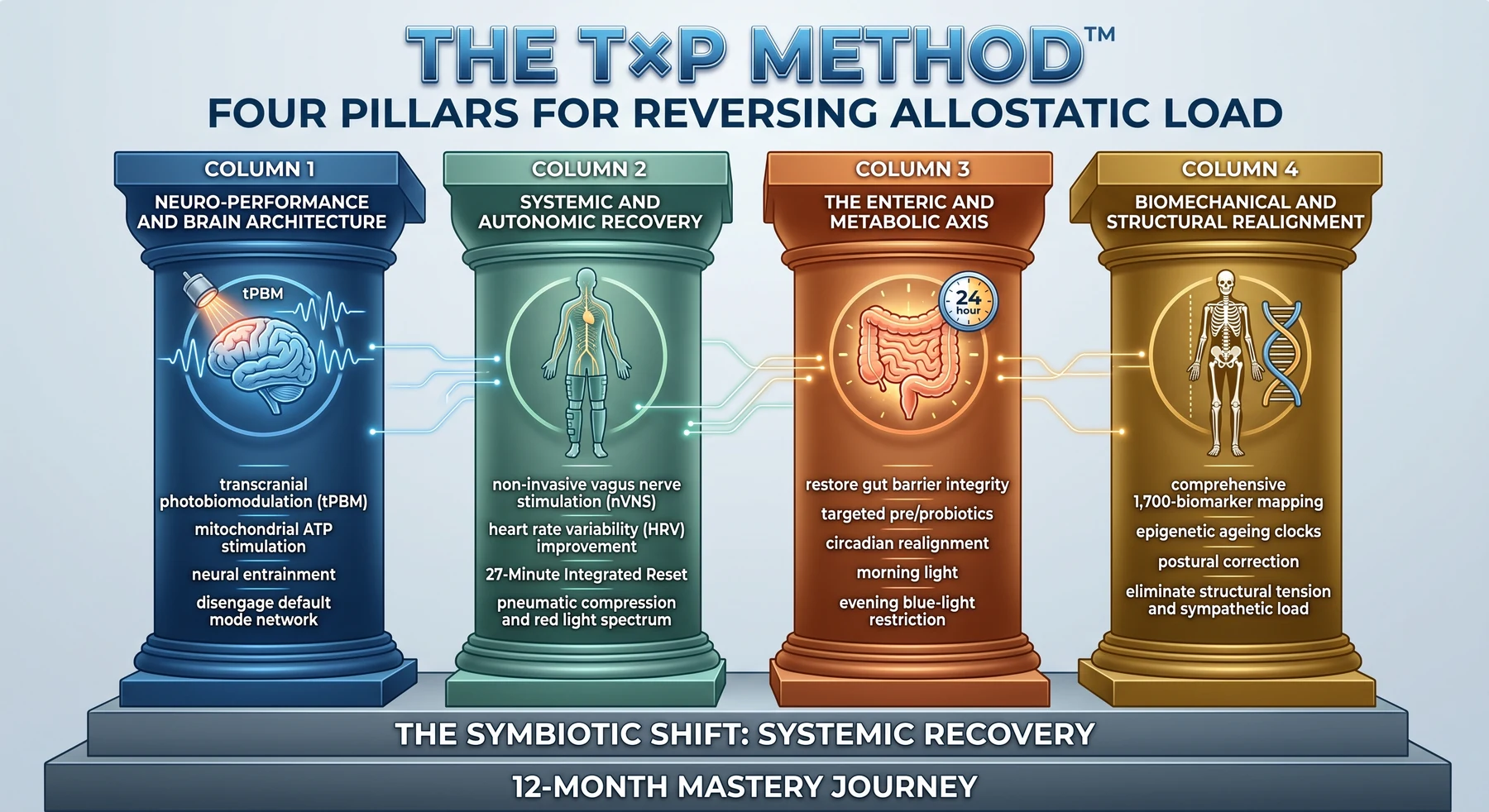
1. Neuro-Performance and Brain Architecture
Chronic stress leaves its clearest fingerprints on the brain, and that’s where recovery begins. Clinical-grade transcranial photobiomodulation delivers near-infrared light to key cortical regions, including the prefrontal cortex, to stimulate mitochondrial energy production and quiet hyperactive stress circuitry. Neural entrainment, using pulsed light and acoustic frequency shifts, moves the nervous system out of chronic sympathetic dominance and into a state where genuine neuroplastic repair becomes possible. Synchronised audiovisual mindfulness sessions further disengage the default mode network, easing the rumination loops that keep the mind locked in threat mode long after the actual threat has passed.
2. Systemic and Autonomic Recovery
The autonomic nervous system is the master regulator of allostatic load, and it needs direct, targeted input to recalibrate. Non-invasive vagus nerve stimulation increases vagal tone, lowers inflammatory cytokine signalling, and measurably improves HRV. This is reinforced through the 27-Minute Integrated Reset, a signature protocol layering calibrated pneumatic compression for lymphatic and vascular support with a nine-wavelength red and near-infrared light spectrum to restore deep tissue and cellular respiration in one compounding session. Structured resonance breathwork, paced at the 0.1 Hz frequency shown to optimise baroreflex sensitivity, completes the reset by restoring carbon dioxide tolerance and calming the respiratory-nervous system link.
3. The Enteric and Metabolic Axis
You cannot resolve allostatic load while the gut is compromised. Chronic cortisol elevation breaks down the tight junctions that keep the intestinal barrier intact, allowing inflammatory compounds to leak into circulation and reinforce stress signalling in the brain, a vicious cycle. Targeted prebiotic and strain-specific probiotic protocols rebuild that barrier and interrupt the feedback loop at its source. Structured circadian realignment, morning light exposure, evening blue-light restriction, and time-restricted feeding, restores a healthy cortisol curve and protects the slow-wave sleep architecture your brain relies on to physically clear metabolic waste overnight.
4. Biomechanical and Structural Realignment
None of this works in isolation from the body’s physical structure. Comprehensive biomarker diagnostics, spanning up to 1,700 data points alongside epigenetic methylation clocks, give an objective, evolving picture of biological age and recovery, not a guess based on how someone feels on a given day. This data is paired with postural and biomechanical correction, because chronic misalignment creates its own low-grade, unnecessary sympathetic load. Relieving that structural tension frees up physiological energy the body can finally redirect toward genuine systemic repair.
From Survival to Growth
This is the shift The T×P Method is built to deliver: moving the body out of a state of perpetual defensive survival and into one of adaptive, regenerative growth. Not by isolating a single symptom and chasing it, but by treating the human being as what it actually is: an interconnected ecosystem, repaired at every level it has been asked to compensate.
Allostatic load didn’t accumulate overnight, and it won’t resolve overnight either. But with the right data, the right protocols, and a framework built around symbiosis rather than isolation, it is entirely reversible. That is the work. That is The T×P Method.
If you’re ready to see where your own allostatic load currently sits and what a structured, twelve-month recovery protocol looks like, this is the conversation to have.
A structured, twelve-month protocol for reversing allostatic overload, built on 1,700-point biomarker diagnostics rather than guesswork.
See the programme →FAQ: Allostatic Load & The T×P Method
Is allostatic load the same as burnout?
No. Burnout is the subjective, felt experience of exhaustion, typically tied to work. Allostatic load is the underlying physiological accumulation, measurable through biomarkers like cortisol slope, heart rate variability, and inflammatory markers, that can exist well before someone feels burnt out, and that continues even after they feel mentally “recovered.”
Can allostatic load be reversed?
Yes. Allostatic load is not a fixed or permanent state. With targeted neuroendocrine, autonomic, gut, and structural interventions, paired with consistent biomarker tracking, the body’s stress-response systems can be recalibrated and biological age markers can measurably improve over time.
How long does it take to reduce allostatic load?
Meaningful shifts in heart rate variability and inflammatory markers can appear within weeks of consistent intervention. Full systemic recalibration, including epigenetic and structural change, takes longer, which is why The T×P Method is structured as a twelve-month program rather than a short-term fix.
What are the first signs of high allostatic load?
Common early indicators include poor sleep quality despite adequate hours, stubborn abdominal weight, reduced resilience to minor stressors, brain fog, and a resting heart rate that stays elevated well after a stressful event has passed.
How is allostatic load actually measured?
Through a multi-system biomarker panel rather than a single test. This includes cortisol awakening response and diurnal slope, DHEA-S ratios, catecholamine output, HbA1c, fasting insulin, high-sensitivity CRP, gut-barrier markers, heart rate variability, and epigenetic DNA methylation clocks. Together, these show not just whether you’re stressed, but whether your body can still recover from it.
Why doesn’t a standard blood test catch allostatic overload?
Standard panels measure isolated markers against broad population reference ranges. Allostatic load is a breakdown in the relationship between systems, the nervous system, gut, hormones, and sleep, so it requires tracking the interplay between markers over time, not a single number on a single day.
Who is The T×P Method for?
Anyone carrying a high, unresolved stress load who wants an evidence-based, structured path back to physiological resilience, including high performers, executives, and individuals whose biomarkers or symptoms suggest chronic allostatic overload rather than a single isolated health issue.
What makes The T×P Method different from general wellness programs?
It’s built around comprehensive biomarker and epigenetic tracking rather than subjective feel, and it treats the body as an interconnected ecosystem, targeting the neuroendocrine, autonomic, gut-metabolic, and structural systems together rather than addressing symptoms in isolation.