
I recently came across an online group created to support people who had left relationships with partners they described as narcissists. What I found inside it shocked me. Aggressive comments. Dehumanising language. Hostile memes. Threats of retaliation. And an extraordinary level of certainty about the psychological diagnoses of people none of the members had ever assessed, and many had never met.
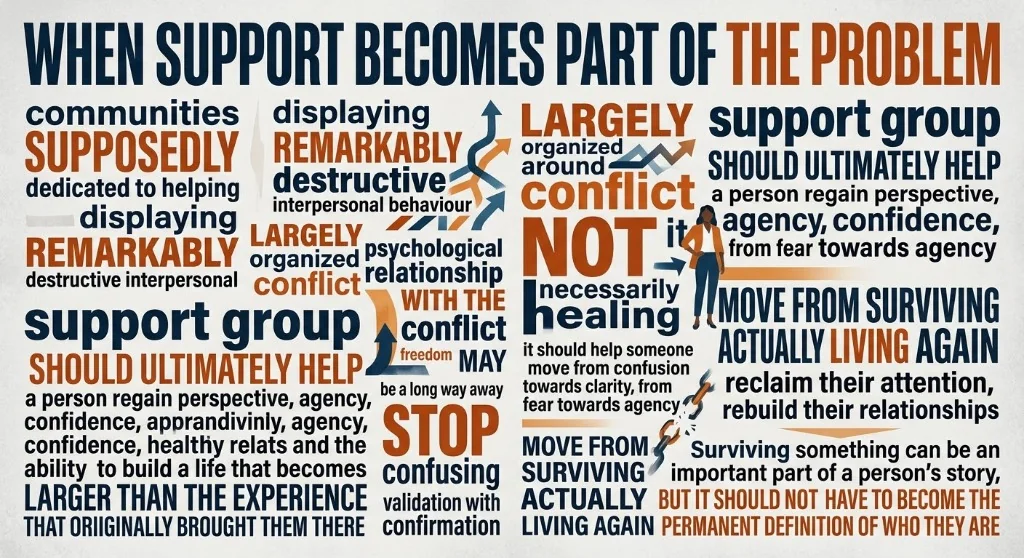
The irony was hard to ignore. A community dedicated to helping people recover from destructive interpersonal behaviour was, in places, displaying remarkably destructive interpersonal behaviour itself.
I want to be careful here, because it would be easy to reproduce the very problem I am describing. None of this makes the members of that group narcissists. Nobody can be diagnosed because someone dislikes their behaviour, and nobody can be reliably diagnosed from a social media post. The point is not that these people are disordered. The point is that something about the way these spaces operate can harm the very people they claim to help.
This is not an argument against people sharing painful experiences, or against supporting someone who has genuinely been abused. It is a concern about what happens when a support culture loses the distinction between personal experience, psychological knowledge and clinical diagnosis, and about the growing number of groups, podcasts and content channels that appear to profit from that confusion.
Why the Word Took Hold
It is worth understanding why the word “narcissist” has become so powerful, because the people reaching for it are not foolish.
Many people leave manipulative relationships no longer trusting their own perceptions. They have been told repeatedly that they are overreacting, misremembering or imagining things. Then they encounter a description of narcissistic behaviour and, for the first time, a confusing and painful experience seems to make sense. The label gives them a vocabulary. It tells them they were not crazy. It tells them other people have lived through the same thing.
That moment of recognition can be genuinely important, and any honest critique of these communities has to begin by acknowledging it. The problem is what often comes next.
A Diagnosis Is Not a Description
Narcissistic Personality Disorder is a specific clinical diagnosis. The American Psychiatric Association describes it as a persistent pattern of grandiosity, need for admiration and impaired empathy, and distinguishes the disorder from the ordinary narcissistic traits most people display at some point. A diagnosis requires a proper assessment against established criteria by someone trained to make it.
Online, the word has become something else entirely: a catch-all for an ex-partner who was selfish, controlling, emotionally unavailable, manipulative, cruel or simply behaved badly. Those behaviours can be deeply damaging and deserve serious discussion. They do not, on their own, establish a personality disorder.
The evidence on how this topic is presented online is sobering. A 2026 content analysis of the most-viewed German-language TikTok videos on six mental health conditions found that only around one in five were factually correct, that videos made by laypeople performed worst, and that every single video on narcissism contained misinformation. A 2025 study of 1,000 TikTok videos across 26 mental health topics found that content on personality disorders frequently portrayed narcissistic and borderline traits in inaccurate or stigmatising ways, often with no clinical basis.
This matters because these videos, posts and podcast episodes are often the first place people in pain go for answers.
You Do Not Need the Label
Here is the reframe I think matters most, and that I believe is genuinely freeing.
Behaviour does not need a diagnosis to be unacceptable. A person does not have to prove that their former partner has a personality disorder in order to justify leaving, setting boundaries, seeking protection or naming what happened as abuse. Controlling behaviour is controlling. Cruelty is cruelty. Manipulation is manipulation. None of it becomes acceptable because the person responsible would not meet clinical criteria for anything.
Focusing on behaviour rather than diagnosis actually serves survivors better. It removes the impossible burden of proving something about another person’s mind, and places attention where the person has real power: on what they experienced, what they will accept in future and how they want to live.
Validation Is Not Confirmation
This leads to a distinction that support communities, and the people who lead them, urgently need to understand.
Validation means acknowledging that someone’s pain is real and that what happened to them sounds genuinely hurtful. Confirmation means agreeing with every interpretation they have formed about the other person, including diagnoses, motives and predictions.
We can do the first without the second. We can recognise that behaviour was unacceptable without diagnosing the person who displayed it. We can support someone who has experienced abuse without turning their alleged perpetrator into a psychiatric case study.
Good support offers validation generously. Unhealthy support offers confirmation automatically, and in doing so it can lock a person into a story that becomes harder to move beyond with every retelling.
Experience Is Not Expertise
A related point needs to be made plainly. Having experienced something does not make a person qualified to diagnose it in someone else.
Someone who has survived a destructive relationship may have real insight into their own experience. They may recognise patterns others have lived through, and their empathy can be enormously valuable to people who feel alone. But personal experience and professional expertise are not interchangeable, and neither is a substitute for clinical assessment.
This becomes especially important when a survivor becomes a group administrator, a coach or a content creator with a large audience. At that point their interpretations stop being personal reflections and start shaping how thousands of vulnerable people understand their own lives.
When Talking Keeps You Stuck
Research on online peer support has found real benefits alongside real risks. A 2025 scoping review in the Journal of Medical Internet Research concluded that while good information is exchanged in these groups, misinformation is a genuine public health concern, and that the quality of information varies with the condition being discussed and the degree of expert moderation present. Many survivor groups have no expert moderation at all.
Psychology also offers a useful concept for what can happen inside these spaces. Developmental psychologist Amanda Rose introduced the term co-rumination to describe excessively discussing problems with others: rehashing them, speculating about them and dwelling on negative feelings. Her research, conducted mainly with young people’s friendships, found a striking trade-off. Co-rumination made relationships feel closer, while also being associated with higher levels of anxiety and depression.
That trade-off describes many survivor communities with uncomfortable accuracy. Members bond intensely over shared stories of what was done to them, and the bonding feels like support. But when the main activity of a group is revisiting, analysing and re-condemning the same people, the closeness can come at the cost of the very recovery members came looking for.
The Business of Staying Hurt
The problem is magnified when a community is attached to a podcast, a channel or a paid program.
The attention economy rewards certainty, villains and strong emotion. Content that names a monster, lists the warning signs and promises to expose how “they” think performs far better than content that says the situation was complicated, the other person was harmful but probably not disordered, and the real work now is on your own life.
That creates an uncomfortable incentive. An audience that recovers, moves on and stops thinking about the person who hurt them is an audience that stops listening. An audience that remains angry, frightened and preoccupied keeps coming back.
I am not suggesting every creator in this space is acting cynically. Many began with genuine intentions and real pain of their own. But the incentive exists whether anyone intends it or not, and it pulls in the opposite direction to healing. Anyone producing this content, and anyone consuming it, should be willing to ask which way it is really pulling them.
Leaving the Relationship, but Not the Conflict
A group created to help people escape an unhealthy relationship can gradually become another environment organised around conflict. The relationship ends, but the psychological relationship with the conflict continues.
A person can stop living with someone while continuing to think about them constantly. They can leave physically while remaining attached to the story, the anger and the identity that grew around it. Physical separation has occurred, but psychological freedom may still be a long way off.
Acknowledging what happened is essential. Organising your identity around what happened is something different. Understanding the past can be necessary, but at some point attention needs to begin moving towards the present and the future.
What Healthy Support Looks Like
For practitioners, and for anyone trying to judge whether a community is helping, a few questions are revealing.
Over time, do members talk more about themselves and less about the person who hurt them, or does the focus on that person stay the same or intensify? Is disagreement possible, or is anyone who questions a diagnosis or interpretation treated as an enemy or an apologist? Are members encouraged towards professional help, new relationships and full lives outside the group, or is the group positioned as the only place that truly understands them? Do people eventually leave because they have recovered, or does belonging become a permanent identity? And are the people leading it qualified, moderated and accountable, or simply the most certain voices in the room?
Healthy support creates movement: from confusion to clarity, from fear to agency, and from preoccupation with another person to a deeper understanding of oneself. It should help someone establish boundaries, rebuild trust in their own judgement and build a life in which the past occupies its proper place.
A Question Worth Asking
We can have deep compassion for survivors and still ask whether certain communities are actually helping them recover. That question should not be off limits simply because it is uncomfortable.
If a community, or a platform built around one, becomes increasingly hostile, obsessive and vindictive, and depends on keeping its audience focused on the people who hurt them, we should have the courage to ask whether it is supporting recovery or simply giving suffering somewhere to live.
The measure of healing is not how vividly someone can keep describing what happened to them. It is their ability to reclaim their attention, rebuild their relationships and take part fully in the life that exists beyond the experience.
Surviving something can be an important part of a person’s story. It should not have to become the whole of it.
References
American Psychiatric Association. (2022). Diagnostic and statistical manual of mental disorders (5th ed., text rev.). American Psychiatric Publishing.
Insufficient quality of mental health information on German-speaking TikTok: A content analysis. (2026). Clinical Psychology in Europe, 8(1). https://doi.org/10.32872/cpe.17279
Navigating the maze of social media disinformation on psychiatric illness and charting paths to reliable information for mental health professionals: Observational study of TikTok videos. (2025). Journal of Medical Internet Research, 27, e64225. https://www.jmir.org/2025/1/e64225
Quality and misinformation about health conditions in online peer support groups: Scoping review. (2025). Journal of Medical Internet Research, 27, e71140. https://www.jmir.org/2025/1/e71140
Rose, A. J. (2002). Co-rumination in the friendships of girls and boys. Child Development, 73(6), 1830–1843.
Rose, A. J. (2021). The costs and benefits of co-rumination. Child Development Perspectives.