ART

A curated collection of original works on the human condition -
oil paintings by Biljana Mancini.

ORIGINAL WORKS · BILJANA MANCINIEST. PERTH, WA2026
The Collection - Original Works

Paintings by Biljana Mancini

Original oil paintings on faith, suffering, and the human condition. Select a piece to read the story behind it.
Enquire about acquisitions
Ray Mancini and artist Biljana Mancini
RAY & BILJANA MANCINITHE STUDIO
The Artists - A Shared Inheritance

The language we never chose

Art was never a hobby in our family. It was inheritance. It was the silent language of my bloodline, spoken long before I understood its grammar.

My late father was a master of charcoal. He could take raw pigment and stone and coax landscapes, wildlife, and portraits from it with such precision that the work seemed to lift off the page, entering three dimensions the paper had no right to hold. But it was never only technical mastery. Every line carried emotional weight. People didn't just look at his work; they stood before it and felt something move through them.

As a boy, I tried to walk in his footsteps. But when I picked up a pencil, something else came through me: dark, unfiltered fragments of childhood pain I didn't yet have words for. The page reflected my subconscious back to me too honestly, too soon. Unsettled by what I was seeing, I put the pencils down after two years and didn't pick them up again for decades. I went looking for myself elsewhere.

But you cannot outrun what's written into you. Even in silence, the pull toward art never left. For years I kept it private, a quiet reverence I carried into everything I built, weaving artistic instinct into every space I occupied without ever calling it what it was. I was drawn to the entire spectrum: hyper-realism, sculpture, abstraction, the unconventional. I just never let myself return to the canvas.

Then the universe intervened.

I met Biljana.

Biljana is a Serbian-born artist whose technical range is difficult to overstate: twenty-four years spent mastering realism, expressionism, and abstraction, moving between them not as separate disciplines but as one continuous vocabulary for capturing the full range of human emotion. What makes her work extraordinary isn't only the years of technical discipline behind it, it's what sits underneath that discipline: a deep, unwavering faith. Biljana's connection to God and her devotion to the Orthodox tradition run through her work like an undercurrent, shaping not just what she paints but how she sees. There is a stillness and a reverence in her process that comes from somewhere beyond technique alone, and it is that quality, more than any brushstroke, that gives her work its power to reach people.

What began as a shared love of art quickly revealed something deeper: a profound alignment in values, in philosophy, in the way we each chose to move through life. Building a life together, and eventually curating and producing her exhibitions across Australia and internationally, has been the single best decision either of us has made.

Watching Biljana breathe life onto a blank canvas did more than reignite something in me. It closed a circle I didn't know was still open. Her fearlessness gave me permission to pick up a brush again. Where my childhood work once held only shadow, I now paint in colour, deliberate, vivid, alive. What was once a legacy of unspoken pain has become a celebration of vitality.

Art is no longer a hidden chapter of my past. It is the living, breathing centre of the world Biljana and I have built together.

Coming 2027 - The First Of Its Kind

A biblical art experience, built for every sense.

Not simply an exhibition to walk past, but a journey to walk through: the story of humanity, meaning, and faith told across light, sound, space, and image at once. Biljana is showcasing over twenty powerful new pieces; Ray is creating the lighting, sound, and story experience that carries visitors through. Dates to be announced early 2027.

A Child Praying (Whispers of Faith) - black and white oil painting by Biljana Mancini
04 · "Whispers of Faith"

A Child Praying

ArtistBiljana Mancini
MediumBlack & white oil on stretched canvas (aluminium frame)
EditionOriginal - Signed (Includes COA)
Dimensions61 × 51 cm
StatusNot for sale

In this striking black and white oil painting, Biljana Mancini captures a moment so intimate it feels almost trespassed upon: a child, hands folded in prayer, cheek resting against those same folded hands, eyes closed, head bowed low enough that prayer and sleep become indistinguishable from one another. It is unclear, and deliberately so, whether this is a child still praying or a child who has simply prayed until exhaustion took over. Biljana leaves that threshold open, because it is precisely that threshold, the place where devotion and depletion meet, that the painting is truly about.

"When I painted this child praying, I was painting my own reflection. The weight of sorrows and struggles, the vulnerability in prayer, and the light of hope for something greater."Biljana Mancini

The monochrome palette is not a stylistic restraint here; it is the entire argument of the piece. By stripping away colour, Biljana removes every element that might let the viewer's eye wander, and what remains is astonishingly intimate: the soft disarray of hair falling loose and untamed, the closed eyes that ask for nothing from the viewer, the folded hands doing double duty as both an act of faith and a place to rest a tired head. Grief and hope, in this painting, do not sit apart from each other. They occupy the exact same gesture.

Raised within the Serbian Orthodox Church, Biljana has carried prayer with her not as ritual observed from a distance, but as something lived, something reached for instinctively in both her hardest and quietest moments. This painting reaches back to her own childhood, to what it felt like to be small and burdened by things too large to name, and to find, in the folding of one's own hands, something steady enough to lean on.

There is a reason black and white achieves what colour could not here. It gives the image the quality of memory, of an icon worn soft by candlelight and time, timeless rather than tethered to any particular moment. The interplay of light and shadow across the child's face does the work colour usually does: it is where all the painting's tenderness and sorrow actually live, in the gentle gradient between illuminated skin and the dark that presses in around it.

To stand before this painting is to be handed something quietly universal: the memory of every time exhaustion and faith arrived together, and the small, private act of folding one's hands became the only place left to put both.

Collection of the artist
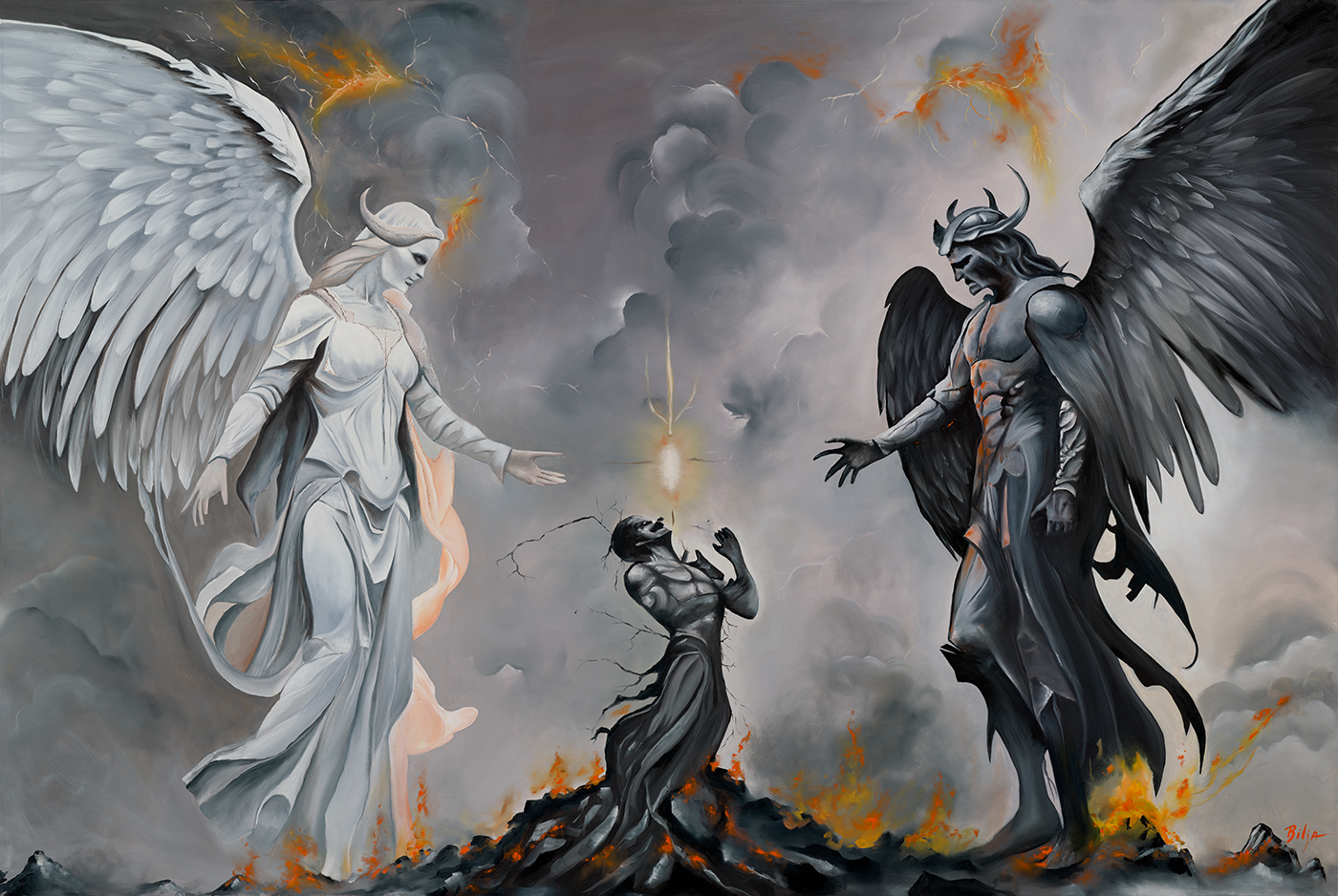
Humanity - oil painting by Biljana Mancini
01 · The Collection

Humanity

ArtistBiljana Mancini
MediumOil on stretched canvas (aluminium frame)
EditionOriginal - Signed (Includes COA)
Year2024
SeriesHumanity Series (01)
Dimensions60 × 90 in · 152 × 229 cm
Price$50,000

At the centre of the canvas, a figure kneels on burning ground. Ash-grey, gaunt, stripped of ornament, they are caught mid-transformation, thin, branch-like tendrils reaching from their back into the scorched earth beneath them, as if something is still rooted to what they are leaving behind. Their face is lifted. Their hands are raised, not in surrender, but in reaching. This is not a figure being rescued. This is a figure choosing, in the one direction available to something with nothing left to lose: up.

Above them, small and impossibly bright against a sky torn by storm and fire, a single point of light burns. It is the only warmth in the composition that asks for nothing. Everything else in the painting is smoke, ash, flame, symmetry, and pull. That light alone is stillness.

And on either side, matched in scale, in stance, in the exact angle of an outstretched hand, stand two beings who mirror each other with unsettling precision.

To the left: radiant, pale, robed in white, wings unfurled in soft, feathered vastness. To the right: horned, armoured, wings of black, a figure carved from shadow and strength. Both reach toward the kneeling figure with the same open palm. Both wear the same expression of quiet, patient invitation. Biljana has not painted good and evil as opposites competing for volume on the canvas. She has painted them as equals in gesture, equals in gravity, because that is the truth of every real threshold a human being crosses: the pull toward destruction rarely announces itself as smaller or uglier than the pull toward grace. It mirrors it. It matches its posture. It waits with the same open hand.

This is the painting's central and most unflinching insight: transformation does not happen at the moment we defeat darkness. It happens at the moment we are standing exactly between two equally weighted forces, and we choose, not because one side is obviously right, but because something in us still reaches for the light instead of the hand nearest to it.

The kneeling figure does not look at either being. They look up, past both of them, toward the one point of brightness that neither the angel nor the adversary controls. This is deliberate. It says something Biljana clearly believes at the core of her practice: that ultimate meaning is not found in choosing between the forces that pull at us, but in remembering there is something beyond both of them worth reaching for in the first place.

The scorched ground beneath all three figures is not incidental. It says the threshold itself is costly. Nothing about this moment is comfortable, easy, or free of consequence. Even the ground has already burned. And still, the figure kneels, and still, they reach.

Humanity does not offer viewers a rescue. It offers them a mirror of the exact posture every person eventually finds themselves in: on scorched ground, between two equally patient forces, arms raised toward a light that asks nothing of us except that we keep reaching for it.

Portrait of Christ - oil painting by Biljana Mancini
03 · The Collection

Portrait of Christ

ArtistBiljana Mancini
MediumOil on stretched canvas (aluminium frame)
EditionOriginal - Signed (Includes COA)
Dimensions104 × 134 cm
Price$12,000

Biljana did not paint this from imagination alone. She painted it from a lifetime of prayer, of standing before icons in candlelight, of the particular stillness that belongs to Orthodox worship, where the sacred is not distant but present, close enough to hold. This is her Christ: not the triumphant figure of judgment, not a symbol rendered at arm's length, but a face caught mid-thought, human in its weariness and divine in its patience.

He is turned nearly in profile, his gaze lowered, directed somewhere just beyond the viewer, as if the weight of everything he carries has settled, for a moment, into quiet contemplation rather than proclamation. This choice matters. Biljana could have painted him looking directly outward, meeting the viewer's eyes in confrontation or invitation. Instead, she paints him looking away, and in doing so, she paints something closer to intimacy than address. You are not being called to. You are being permitted to witness.

His hair falls dark and damp against his face, strands still clinging with what could be water, sweat, or the residue of some unnamed exertion, ordinary, physical, human details that root the divine in a body that once bled and tired and wept. Biljana's technical command is most visible here: the way each strand catches light differently, the way skin and hair and cloth each hold their own distinct weight and texture. This is not stylized reverence. It is observed humanity, rendered with the same precision her father once brought to charcoal, translated now into oil and colour.

Behind him, a deep, restless blue fills the canvas, neither sky nor void exactly, but something both. It surrounds him the way mystery surrounds faith itself: present, enveloping, never fully resolved into simple explanation. Within that blue, a faint halo of lighter tone gathers behind his head, not an ornament borrowed from traditional iconography, but something quieter and more earned, light that seems to emanate rather than decorate.

The white of his garment is the only place the painting fully exhales. Soft, loosely rendered, it wraps him the way grace is often described but rarely shown: not rigid, not perfect, but warm, close, and forgiving of its own imperfections.

This is the heart of what makes Biljana's faith inseparable from her craft. She does not paint religious subjects because tradition asks her to. She paints them because her own relationship with God has shaped how she sees everything, light, suffering, stillness, human dignity, and this portrait is where that vision becomes most direct. There is no ambiguity here, no metaphor standing in for belief. This is devotion made visible, brushstroke by brushstroke, offered to anyone willing to stand before it and be still for a moment themselves.

To look at this painting is to be invited into the same quiet Biljana carries with her: the deep comfort of a faith that does not need to announce itself loudly to be felt entirely.

The Silent Struggle - oil painting by Biljana Mancini
02 · The Collection

The Silent Struggle

ArtistBiljana Mancini
MediumOil on stretched canvas (aluminium frame)
EditionOriginal - Signed (Includes COA)
Dimensions79 × 105 cm
Price$3,500

There is very little colour in this painting, and that is precisely the point.

Biljana strips the palette down to almost nothing: a background that burns from deep red into black, a veil rendered entirely in grey and white, and at the centre of it all, a single human face, the only warmth permitted in the entire composition. Every element that might have distracted, ornament, backdrop, colour, has been removed. What remains is unavoidable: a woman's eyes, meeting yours directly, and refusing to release you.

This is a portrait of a young Romani woman, but Biljana did not paint her as a symbol first and a person second. She painted her the other way around: an individual, specific, unmistakably real, close enough that you notice the small beads of sweat or tears at her hairline, the fine gold thread of her earrings, the single stud catching light at her nose. It is only through this insistence on the particular, this refusal to generalise her subject into an abstraction, that the painting earns the right to speak to something universal. Biljana knows this instinctively: you cannot move people with a symbol. You move them with a face.

That face carries the weight of where Biljana herself began. Raised in a rigid, socialist corner of rural Serbia, she grew up watching the women around her navigate a world that had already decided, long before they were old enough to object, how small their lives were permitted to be. Identity was not something a woman was given room to author. It was assigned, monitored, and corrected. Biljana carried the memory of that atmosphere, the particular exhaustion of being seen but not heard, watched but not known, into every decision she made on this canvas.

The veil is the painting's quiet architecture. It wraps the woman almost completely, shoulders to crown, soft and enveloping, and it is genuinely ambiguous whether it protects her or contains her. Perhaps, Biljana suggests, it has always been both at once: shelter and structure, warmth and restriction, the same fabric doing two opposing things depending on who is looking and why. That ambiguity is not a flaw in the painting's symbolism; it is the entire argument. Most of the forces that shape a woman's life arrive exactly like this, wrapped in something that resembles protection.

Then there is the red.

It rises behind her like heat, like an unspoken emotion the painting refuses to name outright: anger, warning, the residue of everything unsaid. It fades to black at the edges, as if the feeling itself cannot sustain its own intensity indefinitely, as if even fury eventually exhausts itself into something quieter and heavier. Between that red and that black, the woman remains still. Contained. Upright. Her expression does not plead and does not perform distress for the viewer's benefit. It simply endures, and asks to be witnessed while doing so.

Her eyes are pale green, luminous against the surrounding darkness of her hair and the muted veil, and they are the one place in the painting where Biljana allows something to break through the restraint: not softness exactly, but presence. Undeniable presence. They say, without a single word, I am here. I have always been here. You simply were not asked to look.

This is what Biljana means when she calls the painting personal. She is not only remembering the women of her childhood community. She is remembering the specific sensation of being boxed into a role too narrow for who she actually was, of being dismissed before she had finished speaking, of learning to hold an entire interior life behind a composed, still expression because composure was the only form of dignity that was permitted to her.

The Silent Struggle does not ask viewers to pity its subject. It asks something more demanding: to stand still long enough in front of her gaze that looking away starts to feel like the same failure of attention that silenced her in the first place. It is a portrait, but it functions as a reckoning, a reminder that somewhere behind every composed, quiet face is a woman who was never actually silent. She was simply never given the room to be heard.