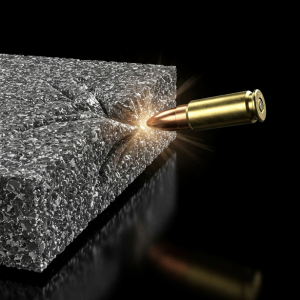
The Physics Behind Bullet-Resistance in Diamene
Diamene’s impact resistance is derived from a remarkable atomic transformation. Composed of precisely two layers of graphene an atomically thin lattice of carbon diamene undergoes a temporary phase shift under mechanical stress. When a high-pressure force is applied, such as the force of an incoming bullet or blade, the carbon atoms reorganize from their standard sp² bonding structure to an sp³ configuration. This new arrangement mirrors that of diamond: one of the hardest known substances in the natural world.
The result is not merely a hardened surface but an ultrafast, localized transition that resists penetration and distributes the incoming force across the structure. Unlike traditional armor, diamene returns to its original, flexible form once the pressure dissipates, offering a dynamic defense system rather than a static shield.
Experimental Validation and Unique Mechanical Profile
Atomic force microscopy has confirmed that bilayer diamene, when compressed, achieves stiffness values approaching or surpassing that of diamond. Notably, this effect is exclusive to two-layer graphene systems; monolayers or multilayers do not exhibit the same transition, highlighting the precision required in its engineering.
This reversibility transforming into a diamond-hard surface on impact and softening immediately after makes diamene uniquely suited for integration into lightweight, high-mobility protective gear.
Dual-Mode Properties: From Defense to Electronics
In addition to its ballistic resilience, diamene possesses extraordinary versatility. The shift from sp² to sp³ hybridization not only enhances its mechanical hardness but also suppresses electrical conductivity, effectively creating a pressure-sensitive insulator. This opens avenues in:
- Spintronics and Quantum Devices: Where tunable bandgap behavior is advantageous
- Flexible Electronics: Devices that demand both structural resilience and thin form factors
- Energy Absorption Systems: Where materials must adapt dynamically to impact or vibration
Theoretical work, particularly by Prof. Angelo Bongiorno and his research team, has shown that this transition is orientation-dependent. Only specific stacking arrangements between the two graphene layers will yield the diamond-like hardening effect.
Practical Applications: Protection, Precision, and Performance
Body Armor and Ballistic Gear
The most immediate and revolutionary application of diamene lies in ballistic protection. Current armor systems, while effective, are often bulky and restrictive. Diamene’s ultra-thin profile, combined with its impact-triggered rigidity, paves the way for next-generation protective wear that conforms to the body under normal conditions but hardens instantly under attack.
Wearable Technology and Smart Clothing
Beyond defense, diamene could be integrated into consumer-level apparel and accessories to provide shock-absorbing properties without compromising flexibility or comfort—especially in sports, industrial safety, and high-risk environments.
Aerospace and Impact-Resistant Components
Due to its low weight and superior hardness, diamene can enhance spacecraft and aircraft componentry, especially in zones vulnerable to micro-impacts, vibration, or wear.
Nano-Resonators and Tribological Systems
Preliminary findings suggest that functionalizing diamene with fluorine or hydrogen reduces its coefficient of friction, making it a candidate for high-performance nano-scale bearings and wear-resistant coatings.
Engineering Challenges and Developmental Horizon
To transition diamene into widespread use, several technological hurdles must be addressed:
Scalable Fabrication
Controlled synthesis of bilayer graphene with precise orientation remains an intricate process. Industrial-scale solutions must ensure consistent layer alignment to preserve the diamond-transition effect.
Environmental Durability
Long-term stability under varying thermal, humidity, and operational loads needs further validation. Surface functionalization and encapsulation techniques may be required to ensure reliability in the field.
Manufacturing Integration
Cost-effective methods for integrating diamene into textiles, composite panels, or multilayered devices must evolve. This includes advances in chemical vapor deposition (CVD), atomic alignment techniques, and automated roll-to-roll production.
Material of the Future
Diamene exists at the frontier of what was once thought impossible: a material thinner than a strand of DNA that behaves like diamond on impact, yet flows like silk in stillness. It reframes our understanding of resilience not as a fixed state, but as a responsive, adaptive quality.
As scientific exploration continues and engineering refinements emerge, diamene may not only protect the future it may help shape it.