
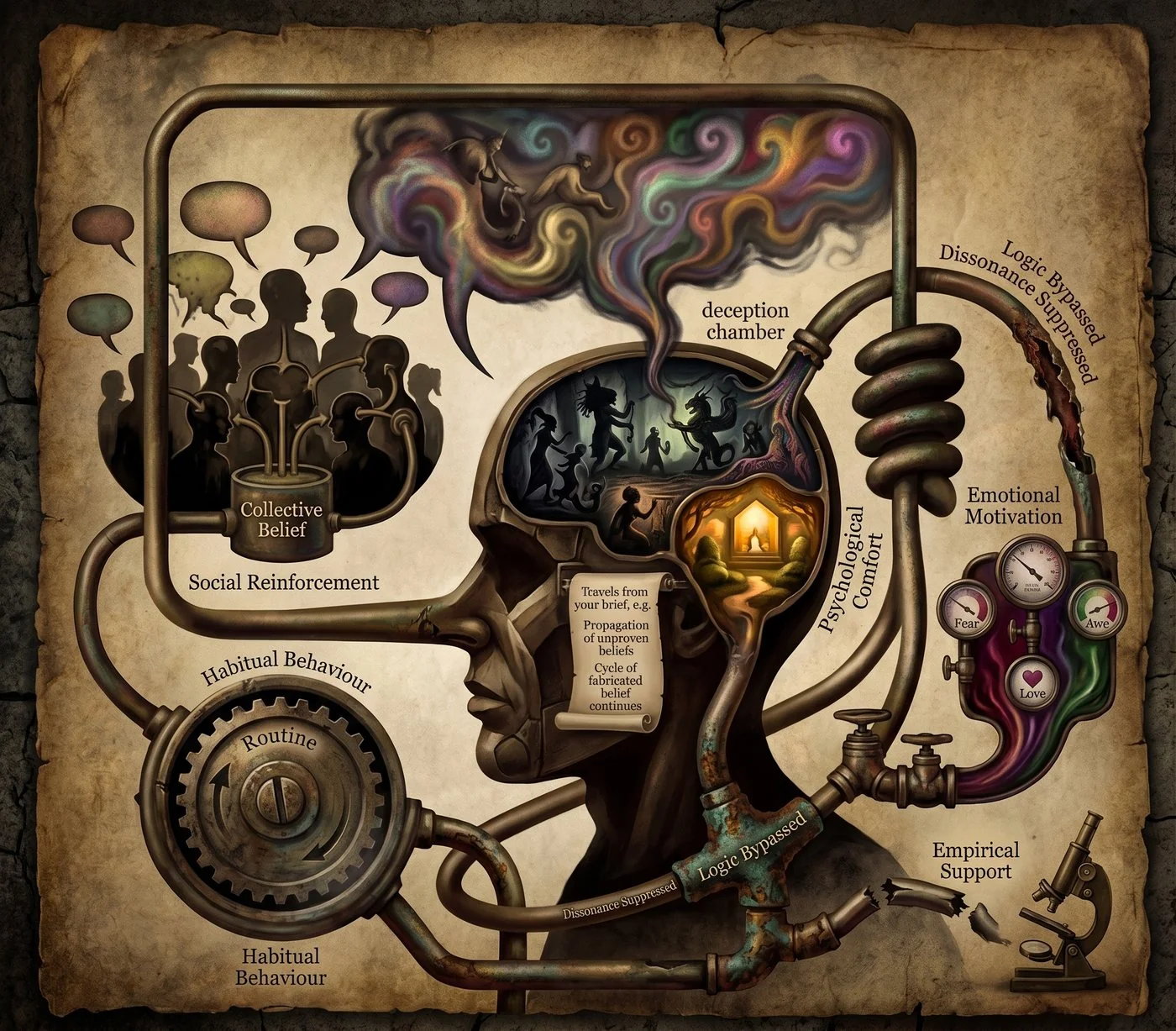
Why do people believe things that cannot be proven? The answer sits at the intersection of psychology, emotion, and survival. There is a moment, buried somewhere in the deep past of our species, when someone first discovered that a story could move a crowd further than a fact ever could. We do not know their name. We do not know what they said. But we have never stopped paying the price of that discovery.
Long before we had the language of psychology to describe it, we had already weaponised the practice: dress an idea in enough wonder, enough fear, enough beauty, and it will outlive the truth standing beside it. Myth, prophecy, legend, ideology. Different costumes on the same engine of manipulation. That engine still runs today, quietly, in boardrooms and pulpits and comment sections, wherever conviction is manufactured faster than evidence can ever hope to catch it.
This is not a piece about liars alone. It is a piece about something harder to face, that the machinery of self-deception lives inside every one of us, ready to be pulled by anyone skilled enough to find the lever. Understanding it is not comfortable work. But refusing to look at it is how the cycle keeps winning.
Seduced by the Unfinished Story
Certainty is rare and hard-won. Meaning is not optional, we cannot live without it. Somewhere in that gap between what we can prove and what we cannot bear to live without, humans built bridges out of narrative, and then mistook the bridge for solid ground.
A claim wrapped in story does something a claim wrapped in data never can: it recruits the imagination as an accomplice. The listener does not simply receive the idea, they help construct it, filling the silences with their own hopes and their own fears. This is why embellishment overpowers evidence so easily. It is not persuasion in the honest sense, it is seduction. And seduction, unlike argument, rarely announces itself as something to resist.
The Comfort of a Convenient Answer
Uncertainty does not feel like inconvenience to the human mind, it feels like danger. Faced with the unknown, we will reach for a fragile answer over an honest absence of one, almost every time. A belief, even a false belief, closes the open wound of not knowing. It buys the nervous system a kind of false peace.
This is not a flaw we can simply reason our way out of. It is wiring. We are built to crave resolution more than we crave truth, and unproven conviction is often the fastest, cheapest resolution on offer. We take it the way an addict takes relief, not because it is good for us, but because it works immediately.
Emotion Decides Before Truth Gets a Vote
Long before reason is even consulted, emotion has already ruled. Ideas arriving dressed in awe, outrage, hope, or dread bypass our slower defences entirely and land directly in the part of us that decides what matters. Once something has captured us emotionally, the case for it no longer needs to survive scrutiny. It only needs to keep feeling true.
This is the uncomfortable truth behind most of history’s most persuasive ideas. They were rarely the most rigorously argued. They were the most ruthlessly felt, engineered or otherwise, to bypass the very faculties that might have stopped them.
When the Groove Becomes the Cage
Belief, once adopted, stops behaving like a conclusion and starts behaving like an addiction to sameness. The mind, like the body, wears a path smooth and then refuses to leave it. Each repetition, in thought, in speech, in ritual, cuts the groove deeper, until thinking any other way starts to feel like a kind of self-betrayal.
This is how conviction outlives the reasoning that first built it, and often outlives its own usefulness. The belief no longer needs to be proven. It only needs to be obeyed, day after day, by a mind that has stopped noticing the difference between habit and truth.
Belonging as a Currency We Cannot Afford to Lose
We rarely hold our beliefs in isolation. We hold them inside tribes, and the tribe has a brutal way of making a belief feel truer simply because everyone around us agrees with it. Shared conviction becomes currency, spent on belonging, on status, on the fragile architecture of self-worth. To question the belief starts to feel like exile.
This is one of the most underestimated and most exploited forces in the entire cycle. People rarely defend the idea itself with such ferocity. What they are truly defending, often without knowing it, is their place among the people who would abandon them for disagreeing.
The Evidence That Arrives Too Late to Matter
Here the cycle closes its jaws. Once a belief has been felt, habituated, and defended by a tribe, contradictory evidence rarely stands a chance against it. It gets absorbed, twisted, or discarded outright, because by the time the evidence arrives, the belief is no longer a hypothesis anyone is willing to test. It has become identity, and people will burn the evidence before they will burn the self.
This is why facts alone so rarely change a mind that matters most. They are arguing with a fortress that was never built out of facts to begin with.
The Reckoning We Keep Refusing
We are still paying, at devastating and often unforgivable scale, for our unwillingness to interrupt this cycle. Toxic storytelling continues to shape politics, markets, faith, and personal identity, while our collective willingness to confront it lags far behind our appetite to exploit it in others, and in ourselves.
Understanding the mechanics, the seduction of story, the comfort of a convenient answer, the tyranny of emotion, the cage of habit, the currency of belonging, will not make anyone immune. But it hands us something we did not have before: the ability to catch a belief in the act of being built inside us, and to demand, before it hardens into identity, whether it has earned the ground it is about to claim.
That single, unflinching pause, repeated with discipline, may be the only real weapon a species this addicted to believing has ever had.
Frequently Asked Questions
Why do people believe things without evidence?
Because unproven beliefs deliver emotional comfort, social belonging, and psychological certainty faster than evidence can, the human mind is wired to prefer resolution over ambiguity.
What is confirmation bias and how does it relate to belief?
Confirmation bias is the tendency to seek out and accept information that supports an existing belief while dismissing or reframing contradictory evidence, it is one of the core mechanisms that keeps the cycle of belief intact.
Can understanding the psychology of belief change how I think?
Awareness will not make anyone immune to emotional reasoning or social pressure, but it creates a pause between the moment a belief forms and the moment it hardens into identity, and that pause is where genuine change becomes possible.