
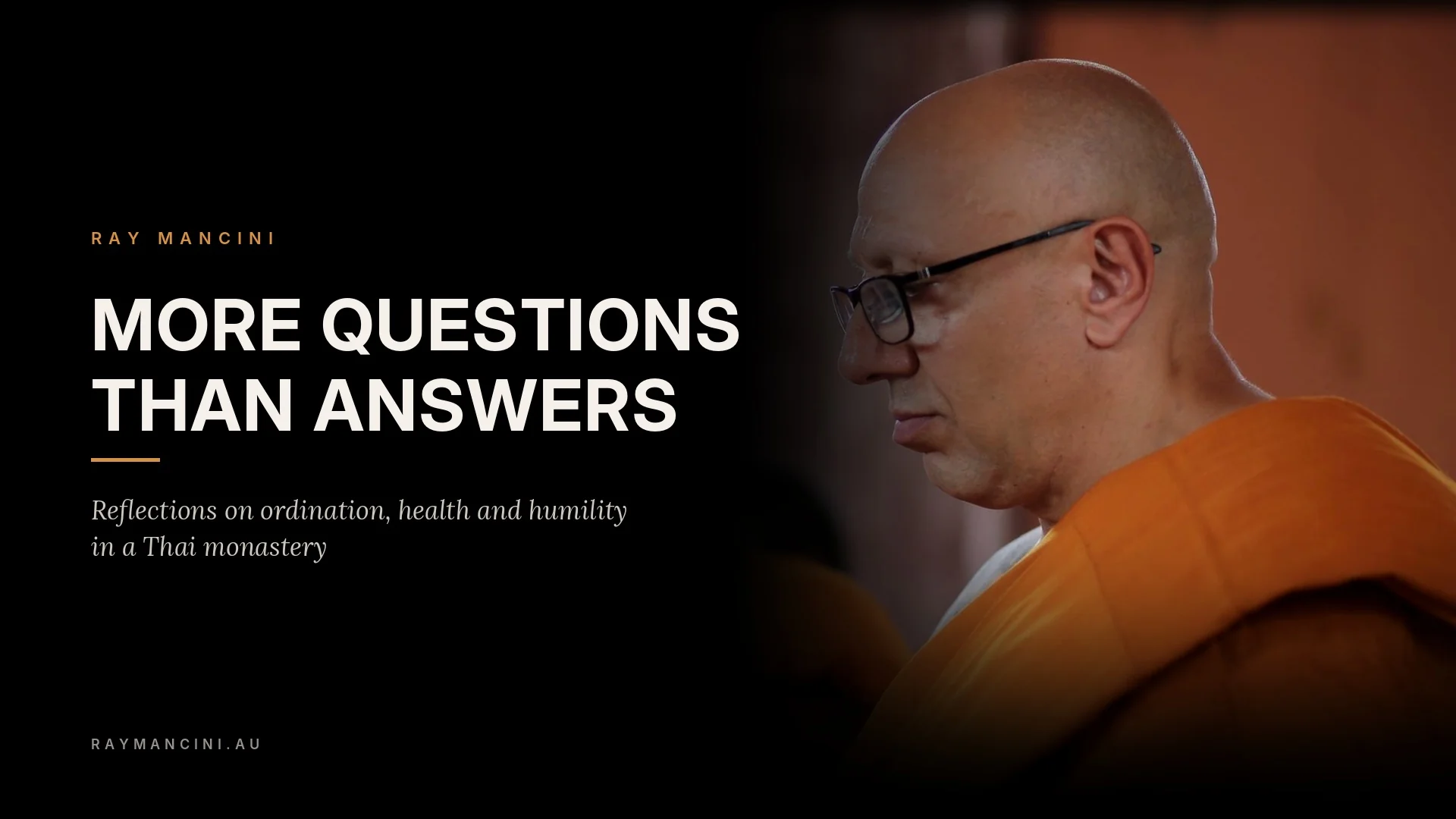
My interest in Buddhist philosophy began when I was very young. Over the decades, a deep curiosity about the mind, consciousness, meditation, and the nature of existence became a lifelong journey of study and personal practice. That journey eventually led me to write two books on Zen and meditation.
In early 2026, at the age of 53, I had the opportunity to take that journey a step further. I travelled to Thailand and was ordained as a Buddhist monk at Wat Ampawan (Wat Don Yai) in Nakhon Sawan.
I entered the monastery without expectations. I wanted to observe, participate, and learn with an open mind and an open heart. I was not there to confirm what I already believed. I was there to understand.
The experience was extraordinary, deeply rewarding, and, in many ways, transformative. Yet I left with far more questions than I had brought with me.
Some were philosophical. Others were practical. A few challenged my understanding of what Buddhist principles are meant to look like in everyday life. I share them here not to criticise Buddhism or the monks who dedicate their lives to it, but to reconcile what I witnessed with what I had spent years studying, contemplating, and writing about.
The body as the vehicle of practice
My first concern was the apparent lack of attention given to physical health. Several monks at the temple appeared to be living with significant health problems, including diabetes. It made me wonder how the relationship between mind and body was understood within the monastic environment.
If the body is the vehicle through which we experience life, practise mindfulness, and pursue spiritual development, should its care not form part of the path? Illness is an inevitable part of the human condition, and not every health problem can be prevented. Still, I wondered why physical wellbeing did not seem to receive greater emphasis.
Food, moderation, and mindful consumption
I was equally surprised by what was eaten. The monks consumed a wide variety of foods, including meat, and on one occasion KFC appeared as part of the morning meal. The two daily meals could be substantial and, at times, seemed far removed from what I would consider balanced nutrition.
I understand that Buddhist traditions interpret dietary rules differently, and that Thai monks rely on whatever the community offers. They do not choose what is placed in their bowls.
My question was never simply whether monks should eat meat. It was about the relationship between nourishment, moderation, awareness, and responsibility for our own wellbeing. If mindfulness means paying attention to our actions and their consequences, should that attention not extend to what we eat and what it does to our bodies?
Tradition, independence, and practical responsibility
Another question concerned the restrictions on monks driving or owning vehicles in Thailand.
Some temples sit in remote areas where transport is limited. I wondered how a monk would reach a hospital in a medical emergency if no one were available to drive.
I had questions about the legal position and its practical consequences. More broadly, I wondered how institutional rules could be reconciled with independence, safety, and reasonable access to essential services. A spiritual way of life should not create unnecessary hardship when straightforward solutions exist.
Smoking and the meaning of mindful living
I was also surprised by how readily tobacco smoking was accepted within the monastery.
I recognise that teachings, monastic rules, and everyday practice are not always the same thing, and that a single habit tells us little about a person's spiritual development. Even so, I struggled to reconcile smoking with mindfulness, non-harming, and care for the body.
This was not about judging individuals. It was about understanding how a habit with such well-known health risks could sit so comfortably within a philosophy that asks us to be aware of the consequences of our actions.
Humility, hierarchy, and the monk's place in the community
Perhaps the most difficult question for me concerned the status afforded to monks.
At gatherings and ceremonies, monks were given priority. They ate first while members of the community waited. On special occasions, people scattered rose petals and flowers along the path as the monks walked.
I understand that these gestures come from deep cultural traditions of reverence and gratitude, and I do not doubt the sincerity of those who offer them. But I found myself asking a more fundamental question: where does genuine humility sit within a system that places some people above others?
If spiritual practice is meant to loosen our attachment to ego, status, and the illusion of a separate self, how do we reconcile that with customs that elevate one group above the rest? Respect for wisdom and dedication is understandable. Gratitude towards those who serve a community is admirable. But respect for a role should never be confused with the idea that the person occupies a higher place in the human hierarchy.
Perhaps the deepest expression of spiritual maturity is found not in being placed above others, but in standing among them without needing to be elevated at all.
Simplicity, renunciation, and neglect
Another area that raised questions was the standard of living in parts of the monastery.
Some facilities were basic and, at times, uncomfortable. Water for washing and bathing was stored in plastic drums and scooped out by hand, even though a simple shower system appeared well within reach.
I appreciate that monastic life embraces simplicity and restraint, and that resources vary greatly from one temple to another. My concern was not that monks should live in luxury. Quite the opposite.
My question was whether there is a meaningful difference between choosing simplicity as a discipline and enduring avoidable discomfort when affordable improvements could support hygiene, health, and dignity. Renunciation need not mean rejecting every improvement that makes daily life safer or healthier. Simplicity should be a conscious choice grounded in wisdom, not an unquestioned acceptance of circumstances that could reasonably be improved.
The body, movement, and balance
Finally, I noticed an apparent lack of emphasis on exercise and structured movement. I wondered whether monks were discouraged from training their bodies and, if so, why.
My own understanding is that physical and psychological wellbeing are deeply interconnected. Movement supports physical health, emotional regulation, cognitive function, and our capacity to meet the challenges of daily life.
I am not suggesting that monks should pursue muscle, athletic performance, or punishing training regimes. Nor do all Buddhist traditions prohibit exercise, because they do not. My question was much simpler: why should caring for the body be seen as incompatible with spiritual development?
A healthy body does not guarantee a wise mind, and physical strength does not produce emotional maturity. Yet body and mind are not separate systems operating independently of one another. If the aim is to cultivate awareness, clarity, discipline, and equanimity, appropriate movement can support that pursuit rather than undermine it.
The questions that remained
These were the questions I carried home. They were not conclusions, and they were never intended as accusations against the monks I lived alongside. They arose from the gap between my understanding of Buddhist philosophy and certain aspects of the monastic life I experienced.
One monastery cannot represent an entire religion. Thai Buddhism lives within a rich cultural and historical context, and the conduct of individual monks cannot define the beliefs of every Buddhist.
Still, the experience taught me something important. Studying a philosophy, practising its principles, and observing how an institution expresses them are three different experiences. Sometimes they align beautifully. Sometimes the differences invite us to look more closely.
My time in Thailand did not diminish my interest in Buddhism. If anything, it deepened it. I returned with a greater appreciation for the discipline and simplicity of monastic life, and with a firmer belief that genuine understanding requires more than accepting traditions, repeating teachings, or assuming that established practice is always the highest expression of the philosophy behind it.
Perhaps one of our most important responsibilities as human beings is to remain curious enough to question what we encounter, humble enough to admit what we do not know, and courageous enough to examine the inconsistencies we observe, including those within traditions we deeply respect.
I do not yet have all the answers. What I do have is a stronger conviction that the pursuit of wisdom should never require us to surrender our capacity for independent thought.
After all, if a philosophy encourages us to see beyond illusion, question our attachments, and understand the nature of reality, should we not also be willing to examine the traditions, institutions, and behaviours that claim to represent it?