
Download the branded edition (PDF)
Imagine a knock at the door. A police officer hands you a court order. From that moment you may be barred from your own home, forbidden from contacting people you love, possibly including your children, and stripped of every firearm and firearms licence you hold. You were not in the courtroom when it was made. You were not told it was coming. The magistrate who made it heard one side only, and was required by law to accept that side's sworn account.
Now imagine you put the paperwork in a drawer. Perhaps you did not understand it. Perhaps English is your second language, or you were in hospital, or you assumed this was the end of the matter. Twenty-one days later, without any further hearing and without a magistrate ever looking at it again, that order becomes final. Usually for two years.
This is not a hypothetical about some distant jurisdiction. It is how Western Australia's Restraining Orders Act 1997 works, today, by design.
And here is the part that should alarm every reader, whether you are someone who has lived through family violence, a parent, a gun owner, a lawyer or simply someone who believes courts should be able to show their work: the State of Western Australia does not publish how often it happens.
The 21-day trap
Under the Act, a person seeking a Family Violence Restraining Order or Violence Restraining Order can ask for the first hearing to be held without the other person present. That hearing is held behind closed doors, and the law says the magistrate must accept the applicant's affidavit in support of what it alleges (section 28). An interim order made on that untested evidence takes effect the moment it is served.
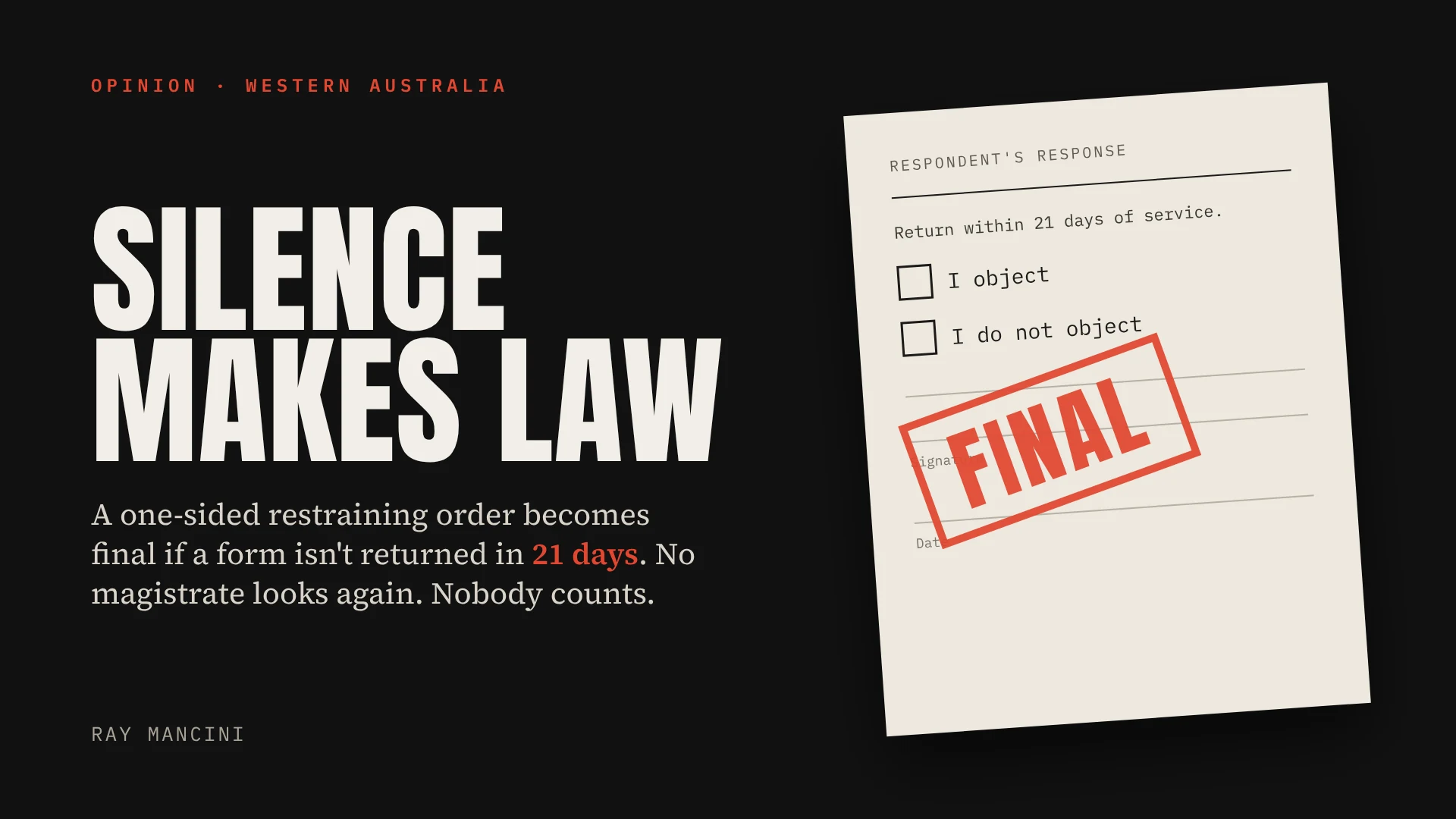
The respondent then has 21 days to fill in a form and send it back. Tick "object" and the case heads to a hearing. Tick "no objection", or do nothing at all, and the interim order automatically becomes a final order on exactly the same terms (sections 31 and 32). That is not my characterisation. It is what Legal Aid WA tells the public.
There is a way back. A person whose order became final because they missed the deadline can apply to have it set aside, but only by proving they had a reasonable cause for not responding, and they stay bound by the final order while they try (section 32(5) to (10)). Note what the test is about: not whether the allegations were true, but whether the paperwork failure was excusable.
How many people end up with final orders this way? The only published figure I can find is more than a decade old. When the WA Ombudsman investigated in 2015, it found that in its study period 14,417 interim orders were made. Of those, 6,351 became final without ever returning to court. Only 2,867 final orders were made after a hearing (Ombudsman WA, 2015). On those numbers, roughly seven in every ten final orders in that period were never the subject of a final hearing.
Some of those people genuinely accepted the order. Some did not dispute what was alleged. But some were surely confused, unwell, homeless, in custody or simply overwhelmed. The data could not tell them apart then. It cannot tell them apart now, because the Magistrates Court's published statistics count how many applications come in, more than 17,000 in 2022/23, and say nothing about how they end.
A justice system that cannot tell you how many of its orders were made by default is not a justice system that is checking its own work.
A justice system that cannot tell you how many of its orders were made by default is not a justice system that is checking its own work.
Seven years without a licence for signing a form
Since 31 March 2025 the stakes have risen sharply, and almost nobody outside the shooting community has noticed.
Every FVRO and VRO, including an interim order made before you have said a word in your own defence, automatically bans you from possessing firearms and holding a firearms licence (section 14). That much has long been the case. But under the new Firearms Act 2024, a final FVRO or VRO is a "disqualifying order", and the Firearms Regulations 2024 extend the disqualification for five years after the order ends. On the face of the law, a two-year order that became final because a form was not returned can keep a farmer, a ranger, a licensed security officer or a professional shooter out of their livelihood for about seven years.
It gets stranger. The Act offers people a way to resolve family violence cases without a fight, called a conduct agreement. The Act states in plain terms that agreeing to one is not an admission of anything alleged (section 10H). Yet the Firearms Act lists conduct agreement orders as disqualifying orders, with the same five-year tail as an order made after a court has heard both sides and found violence proved.
So the law tells you that agreeing admits nothing, and then punishes you for agreeing exactly as if you had been found to have done it. If that sounds fair to you, ask whether anyone signing a conduct agreement is even told.
Let me be clear about what I am not saying. People who pose a risk should not have guns. The automatic ban while an order is in force should stay. Firearms in the hands of a dangerous person turn fear into funerals. But a consequence that outlives the order by five years, applied identically to proven violence and to agreements that admit nothing, deserves a hard public look.
The law tells you that agreeing admits nothing, and then punishes you for agreeing exactly as if you had been found to have done it.
This is not an article about lying women
Some readers arrived here hoping I would say that false restraining orders are an epidemic. I will not, because nobody can prove it, and anyone who tells you otherwise is guessing. There is no reliable Western Australian figure for how many applications are fabricated, by women, by men or by anyone. The fact that most applicants are women tells you who seeks protection. It tells you nothing about who is telling the truth.
But here is what the "it never happens" crowd has to reckon with. Parliament itself wrote into the Act that police and courts must identify the person most in need of protection and must recognise that perpetrators of family violence may try to misuse the Act to further their violence (section 10B). The WA Court of Appeal has held that using legal procedures for an improper purpose can itself be intimidating abuse (Baron v Walsh [2014] WASCA 124). And national research has documented victims, many of them women, being wrongly named as the respondent because their abuser told the story first (ANROWS, 2020).
Misuse is real enough that Parliament legislated against it. How often it happens is unknown. Both of those statements are true, and both camps in this debate need to stop pretending one of them is false.
The system is failing victims too
If you think this is a respondents' rights piece, read the next paragraph twice.
When the Ombudsman reviewed 30 family and domestic violence deaths, it found that in 17 of them at least one person had been granted a restraining order at some point. In one case, the person who was killed had applied for an order and had been refused. Aboriginal people were half of those killed, but only 11 per cent of the people that family-relationship orders sought to protect (Ombudsman WA, 2015). The best Australian research review finds that protection orders do reduce further abuse, modestly but measurably (Australian Institute of Criminology, 2018). Orders save lives. The people most at risk are not getting them.
In 2020 a cross-party Parliamentary committee found the Magistrates Court was taking too long to hear and finalise family violence restraining order cases, did not have enough magistrates to cope, and that legal help for respondents was almost entirely unavailable while applicants were short of help too. It found that when both sides had lawyers, cases resolved faster and orders were more likely to be obeyed.
Read that again. A system that leaves respondents without lawyers does not just risk unfair orders. It produces orders that are less likely to be followed. Unfairness to the accused and danger to victims are not opposites. In this system they grow from the same root: too few resources, too little scrutiny and almost no transparency.
Unfairness to the accused and danger to victims are not opposites. In this system they grow from the same root.
Your children are not paperwork
An FVRO is not a parenting order. It does not decide who a child lives with. But depending on how it is drafted, it can stop a parent attending school events, collecting a child or even sending a text about pick-up times, overnight, months before any contested hearing. The Act says the possibility of family court proceedings is not by itself a reason to refuse an order (section 10D(3)), and it requires the court to consider existing parenting orders (section 10F). How often interim orders cut across safe, established arrangements, and how long those children wait, nobody publishes.
Children must be protected from violence. Full stop. But a child who loses a safe parent for a year because of a missed form, or a backlog, has also been harmed by the State. Both of those children deserve to be counted.
What the Government must answer
These are not radical questions. Any well-run institution could answer them in a fortnight.
How many interim orders became final because the respondent did not respond, how many by consent, how many after a contested hearing, and how many were dismissed? How many people applied to set aside a default order, and how many succeeded? How long does a respondent wait for a hearing when an order keeps them from their home, their children or their work, despite the Act demanding that hearing "as soon as practicable" (section 33(2))? How many firearms licences have been suspended or revoked because of restraining orders since March 2025, and how many because of agreements that admitted nothing? How often do courts find an application was knowingly false, or that the wrong person was named? And the Act itself provides for a review of its family violence reforms (section 73A). Where is it? And which of the fixes below could begin tomorrow, with the staff and systems the State already has?
If the answers are reassuring, publish them and end this argument. If they are not, the public has a right to know.
Fix it fast, fix it cheaply, and keep protection intact
Nothing I propose makes it harder for a frightened person to get an urgent order. Keep without-notice orders. Keep the automatic firearms ban while orders are in force. And before anyone says reform is too expensive, look at what the system already has.
The Magistrates Court already runs an electronic case management system and already accepts customised requests for its data. Registrars are already required to serve every respondent with a document explaining the order (section 8). Police are already required, where practicable, to give the court certificates of a respondent's convictions and police incident reports (section 10F). Shuttle conferences with duty lawyers already run at five courts. The Chief Magistrate can issue practice directions, and none currently in force deals specifically with restraining orders. Most of the machinery for better decisions is already built. It is simply not being used to measure itself.
So start with what costs least. Within three months, using existing staff and existing powers, the Government could publish how interim orders have ended since 2017; rewrite the respondent notice in plain language and community languages; tell anyone considering a conduct agreement, in writing, what it means for their firearms licence; require police to confirm that an order was valid and in force before charging anyone with breaching it; and publish the review the Act already requires (section 73A). None of these needs legislation, a new computer system or a new agency.
Then test before spending. Pilot a text reminder before the 21-day deadline at one court, as Queensland already does for defendants on bail. Pilot a duty lawyer for respondents at one objection list, funded separately so applicant services are not cut. Pilot a short written record of the grounds for every interim order, if the Chief Magistrate agrees. Judge each pilot against hard measures: fewer orders made final by silence, faster hearings, no fall in protection, and no applicants deterred. Scale only what works.
Only then legislate. Give magistrates a brief look at the file before an order becomes final by default, where it removes someone from their home, their children or their livelihood, with the interim order staying fully in force. Make publishing outcome data a legal duty. Require an independent review of the Act every five years. And before anyone touches the five-year firearms disqualification, wait for Parliament's own review of the Firearms Act and assess the risk to life first.
None of this is free. Staff time, translation and pilots cost money, and duty lawyers cost real money. But the Government should be required to say, publicly and within three months, which of these measures it will start now, which within a set period, which need more work, and which it rejects and why. The full dossier tests every one of them for cost, legal authority and risk.
The question nobody in power wants to answer
Every year, thousands of Western Australians are bound by orders that can take their home, their guns, their job and time with their children. Every year, thousands more go to court because they are afraid for their lives. Both groups are entitled to a system that works. Neither can currently be told whether it does.
A court order is the State's solemn word. It should never be given carelessly, never be refused carelessly, and never become final simply because nobody was watching.
Western Australia needs an independent, transparent, evidence-based review of its restraining order system, and it needs it now. Protection without fairness is not justice. Fairness without protection is not safety. Silence is neither.
This article is general commentary and not legal advice. Anyone affected by a restraining order should seek advice from a lawyer, Legal Aid WA or a community legal centre. Law and figures as verified at 9 October 2026.