
A map that surprised its maker
The first edition of the Master Civilisational Systems Map began with a feeling: that the world had become a machine that takes more and more from us. I tested that feeling against 44 systems across human history, from forager societies to the platforms on our phones, and spent an entire stage of the work trying to prove myself wrong.
The feeling did not survive intact. Every major mechanism of extraction, from debt and tribute to measurement and persuasion, already existed more than three thousand years ago. Over the last two centuries, human beings were taken off the market. Child mortality fell from around one in two to around one in twenty-five. And yet the taking had not stopped. It had moved: toward the living planet, where seven of nine planetary boundaries have now been crossed, and toward the mind, where systems can now watch, predict and adjust what millions of people see in real time.
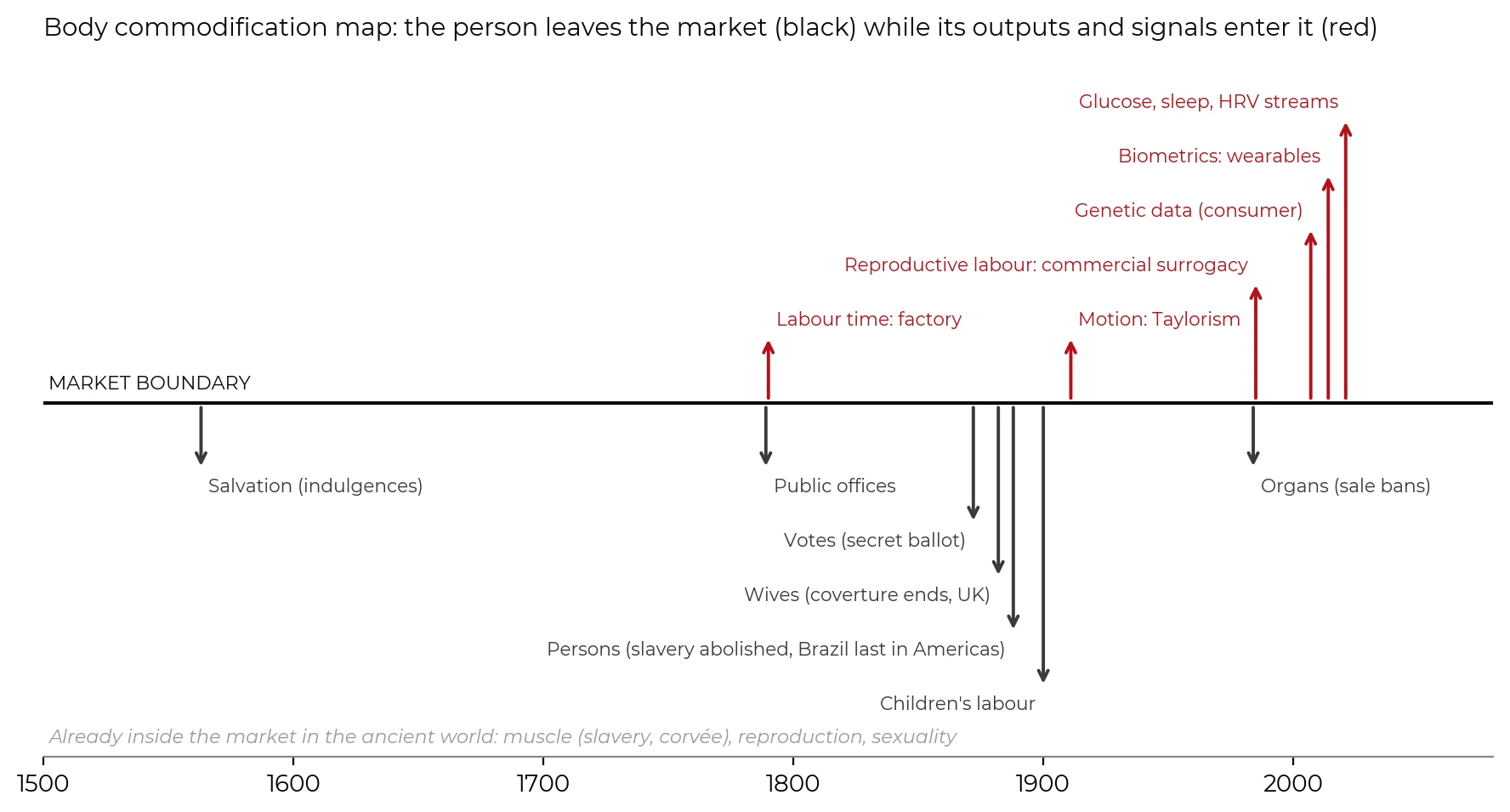
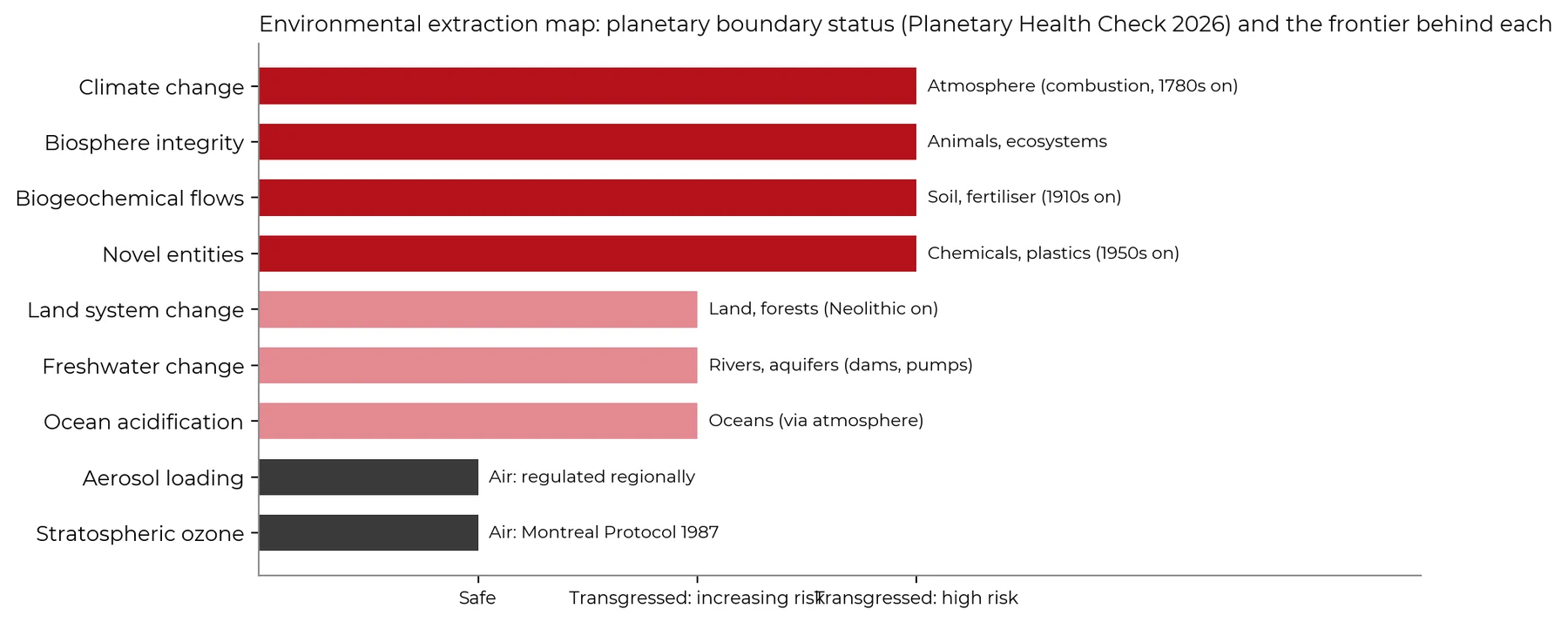
The first edition ended with a model built around a single idea. Successful coordination concentrates flows through chokepoints, and whether those chokepoints serve people or extract from them depends on who controls them, and whether anything is big enough to push back.
That is a good explanation. But it left the most important question unanswered.
The question the first edition could not answer
Why do some systems stay accountable while others turn extractive?
Public libraries, open internet protocols and village commons have concentrated essential flows for centuries without becoming traps. Other systems, built for equally good reasons, drifted into extraction. The first edition could describe both outcomes. It could not reliably predict which one a new system would reach.
A description tells you what happened. An instrument tells you what is likely to happen next, and it can be checked. The second edition sets out to turn the map into an instrument.
Its central question is this:
How does coordination become concentration, how does concentration become power, and what determines whether power remains accountable to the humans and environments it depends upon?
The new central idea
The first edition asked whether civilisation has become a machine for extraction. The second edition reframes that question entirely.
The history of civilisation may be understood not simply as a history of progress or exploitation, but as an ongoing struggle between the expansion of coordination capacity and the capacity to keep the power created by that coordination accountable to the systems it serves.
In this view, progress and extraction are not opposites on a single line. They are two possible outcomes of the same process. Every time humanity learns to cooperate at a larger scale, it creates new power. The question is always whether that power stays answerable to the people and environments it depends on.
The Civilisational Engine
At the heart of the second edition is one model, which I call the Civilisational Engine. It traces how systems typically develop:
Need → Coordination → Legibility → Concentration → Dependency → Chokepoint → Power
A need arises. People coordinate to meet it. The system learns to measure what it manages. Flows concentrate. People come to depend on the system. A chokepoint forms. And whoever controls the chokepoint holds power.
From there, a system can take one of two paths. On the first, power meets accountability, or is held by controllers who expect to bear the long-run costs themselves, and the result is stewardship and resilience. On the second, power slides into proxy capture and externalisation, and the result is extraction, followed by resistance and then reform, collapse or entrenchment.
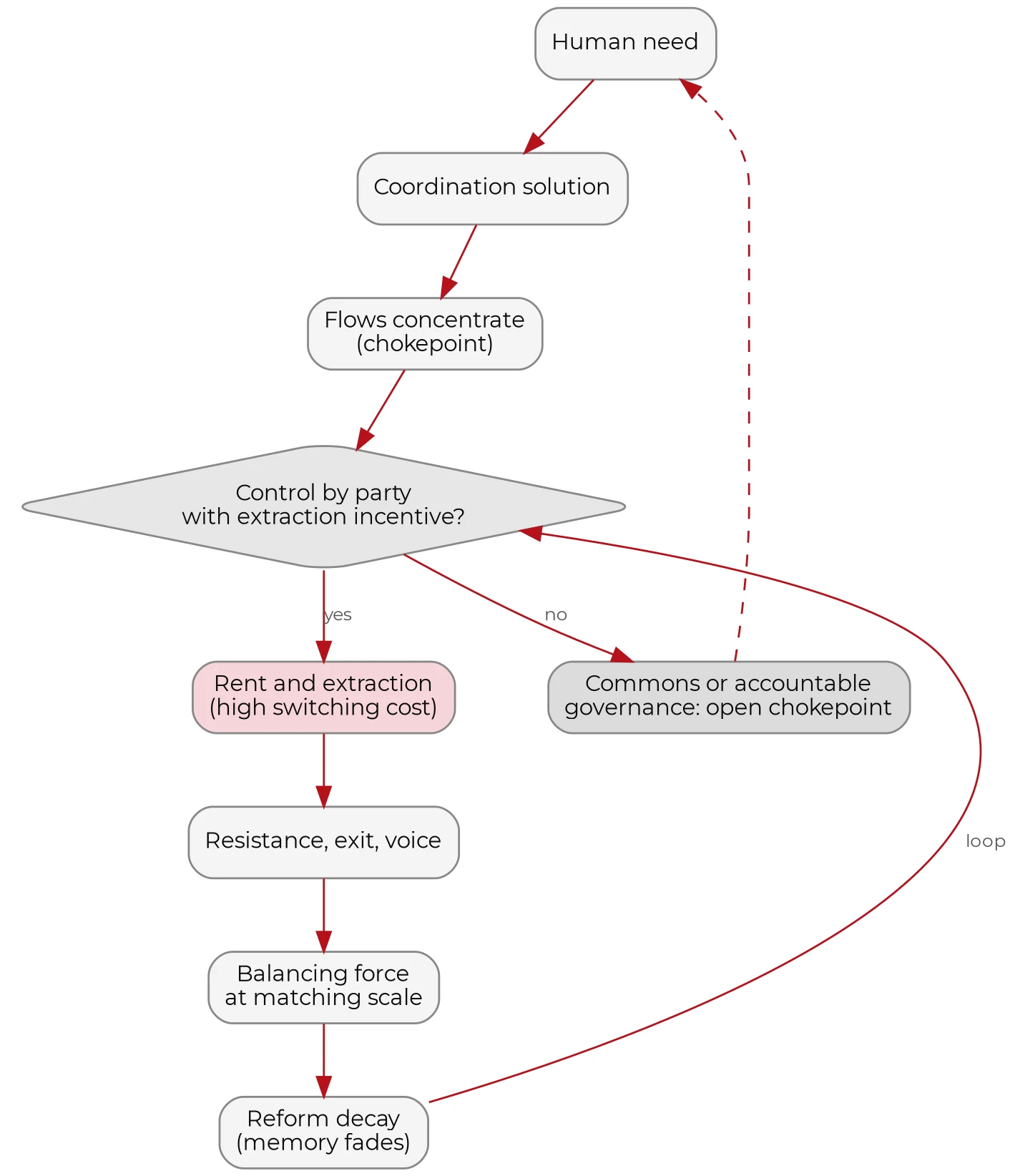
Three refinements make the engine more honest than a simple story of decline:
- Not every system starts with good intentions. Some begin as coordination and drift into extraction. Some were designed for predation from the start, like the Congo Free State. And some are captured and converted, as when the Inca labour system was repurposed by Spain to work the silver mines of Potosí. The second edition codes all three routes.
- The stages are states, not a staircase. Systems do not have to pass through them in order, and when they don’t, that tells us something.
- Both paths loop. Stewardship decays when people forget why it was built. Extraction can be reformed. The historical record shows systems going round these loops again and again.
Measuring causes and effects separately
This is the least glamorous change in the second edition, and the most important.
A tempting way to predict extraction is to say that it happens wherever accountability is missing. The trouble is that “missing accountability” is very nearly the definition of extraction. A model built that way is true by definition, which means it can never be wrong, which means it can never be tested.
So the second edition separates the two. It measures eight conditions that might predict extraction:
- How concentrated the flow is
- How costly it is to go around the chokepoint
- Whether its controller is rewarded for taking more
- Whether the people affected can see how it works
- Whether they can change the rules
- Whether they can leave
- Whether any counterweight operates at the same scale
- Whether the controller expects to bear the long-run costs
It then measures five outcomes independently, ideally by different researchers who cannot see each other’s scores: how much value controllers capture, how much cost is pushed onto others, what happens to the welfare of those who depend on the system, how much coercion is involved, and how far the system’s measures of success have drifted from the needs they were meant to track.
If the eight conditions predict the five outcomes, the model works. If they don’t, we will know, and so will you.
When the map replaces the territory
There is a quiet irony in a project called a map, because one of the second edition’s central themes is what happens when maps take over.
Every large system relies on measures: GDP for wellbeing, test scores for learning, biomarkers for health, engagement for connection, shareholder return for business value, publication counts for science. These measures are useful. But over time, institutions tend to start optimising the measure itself, while the thing it was meant to represent is left behind. The representation begins to replace the reality.
The second edition treats this “proxy capture” as one of the main ways good systems go wrong, and asks a practical question: at what point does a useful measure become the thing being served?
Designed to be proven wrong
The first edition tried to prove itself wrong at the end. The second edition builds that test into every step.
- Every major claim carries its strongest counterargument, the evidence against it, alternative explanations, and a statement of what evidence would prove it false.
- All 44 first-edition cases will be recoded using a common template and a written codebook with clear scoring rules.
- A new set of cases, chosen at random rather than by me, will test the model on systems it was not built from.
- Predictions will be written down and time-stamped publicly before the outcomes are scored, so no one can adjust them after the fact.
- The model must beat simpler rivals. If a single variable, such as market concentration or type of government, predicts extraction just as well, the extra complexity is not justified, and I will say so.
- Failures will be published, including every case where the model predicted extraction that did not happen, or missed extraction that did.
This is a demanding standard, and the framework is honest about it. Where a claim has been tested, the second edition will say so. Where it remains a hypothesis, it will say that too.
Standing on the shoulders of others
Ideas like these have a long history, and the second edition names its debts openly. Elinor Ostrom built a general framework for analysing institutions. Daron Acemoglu and James Robinson made “extractive institutions” a central idea in economics. Tim Wu traced how information industries move from open to closed. Rebecca Giblin and Cory Doctorow, and separately Henry Farrell and Abraham Newman, have written about chokepoints in modern markets and global networks. Charles Goodhart and Donald Campbell described how measures degrade when they become targets.
What the second edition adds is a single framework that follows the same dynamic across all of human history, across scales from a community to the planet, and into biological and digital systems. It treats counterpower as seriously as power, and it is built to be tested.
From one book to three tools
The first edition’s greatest weakness was its size: 109 pages that few people will read cover to cover. The second edition will be published as three connected products:
- The framework: the full argument, evidence and test results, for readers who want the depth.
- The diagnostic toolkit: a short scorecard anyone can use to assess an institution, technology, business or policy in under an hour.
- The case library: every coded case, with its sources and confidence ratings, open for anyone to check and challenge.
The toolkit is the part I am most excited about. The aim is that you should be able to look at any system in your own life, from your workplace to the apps on your phone, and ask the questions that matter.
The open questions
Two questions are deliberately left open.
The first is artificial intelligence. AI may combine every capability that makes systems powerful: scale, speed, fine-grained measurement, continuous feedback and the ability to adapt in real time. Does it create genuinely new mechanisms of power, or does it amplify very old ones? The second edition treats this as a question to be investigated, not a conclusion to be defended. Because AI tools assisted this research, that chapter will also be reviewed by independent human experts.
The second is whether the same patterns repeat across scales, from individual habits to relationships, organisations, nations and the planet. It is a fascinating possibility. It is also exactly the kind of idea that is easy to believe and hard to prove, so the second edition will test it as an exploratory hypothesis, with the conditions that would disprove it stated in advance.
What the second edition will not become
Some commitments are easier to make in advance. The second edition will not become a catalogue of atrocities, a generic critique of capitalism, a manifesto against technology, an argument against progress, a conspiracy theory, a ranking of civilisations, or a theory that humans are destined to exploit one another. It must be able to recognise success as clearly as failure, and benefit as clearly as harm.
Where the work stands
To be clear about what you are downloading: the document below is the Second Edition Development Framework. It sets out the architecture, the definitions, the measurement rules and the testing design. The recoding, the new cases and the test results are still to come, and they will be published when the work is done, not before.
Help test it
A framework built to be proven wrong needs critics. If you are a historian, economist, ecologist, social scientist or simply someone with a sharp eye for a weak argument, I would value your challenge. Read the framework, find the flaws, and get in touch.
The first edition asked whether civilisation has become a machine that takes. The second edition asks something more useful: how we can tell, early enough to do something about it, whether the systems we build will keep serving the people who depend on them.
Progress is not a line we ride. It is an architecture we choose.
Read the work itself
The Second Edition Development Framework sets out the architecture, definitions, measurement rules and testing design in full. The First Edition remains available as the complete 109-page study the second edition is built on.